Gilberthorpe school

Gilberthorpe school
Showing posts with label Collaboration. Show all posts

Friday, 13 December 2019

The Creative Brain

What's a Saturday morning with no sport... Netflix has provided! Check out the preview:
This morning I fell upon THE CREATIVE BRAIN. It promised to take audiences on a journey with neuroscientist and best-selling author, David Eagleman, to meet accomplished professionals from across the creative spectrum, unravel the creative process, and encourage all of us to be more creative.

As teachers, it's crucial that we understand this concept. We are in the creative age (not the digital age, as some still believe). Creativity is a fundamental piece that our educational experiences are lacking. WFRC has been telling us this for the past few years, however I think teachers lack the understanding of what that means. It's not "creating", in the traditional sense.
Creativity is the ability to take on new information and put it together with what we already know.
Humans have transformed the world we live in like no other species. People often link creativity with the arts, however, it is so much more than that. To consider what doesn't exist. To rise above our instincts and consider our other options before deciding what to do.

Most animals have the input and output parts of the brain right next to each other, so there's a direct path between the two. There's an instant reaction. Not much happens in between. Our brains are wired differently, we are able to disengage our instinct to see it differently. Input can collide with what's already there to forge new pathways, make new connections... considering possibility based on what's already there. We can process information in limitless ways. The enlargement of the human cortex, the expansion of the prefrontal cortex behind the forehead... This gives us imagination.

Being original is not about generating something out of nothing

Michael Chabon - Novelist attempts to debunk the theory saying there never has been such a thing as a truly original idea. A Pulitzer Prize winner that's not afraid to take ideas from anywhere, he operates on a basis of instead of "how can I make mine different from my predecessors? How can I utilize what they did to make mine better?"

What we create is unique because our life experiences are unique.
It's about getting out into the world and generate new concepts. Take the ordinary and make them extraordinary by putting them in a yet unseen combination. The creative process often involves making something, yet it also has the power to remake our lives.

Ehron Tool - Potter. He was a Gulf War veteran. He came back with a notion to do something different with his life. His creative outlet allows him to create discussion, generate a feeling. It's become a real healing process.

Lafayette Correctional Centre runs a groundbreaking programme by writer Zachery Lazar. His father had been murdered and this impacted his entire life. Upon visiting a correctional facility as a journalist he realised something surprising. He was surprised by a connection he felt to a lot of the people he talked to. He felt that there was a real lack of creativity in the prison. He felt that by harnessing those people's creativity, it could be a way of preventing them from being in the prison cycle. He now works with the prisoners to nurture their creative writing skills. The impact has been described as helping them think differently about things, think differently about themselves and think differently about other people. They are able to see themselves. It's about changing the narrative.
Tim Robbins (of Shawshank Redemption fame) runs acting workshops with prisoners. Often prisoners are defined by their mistakes made and any potential is never considered. By telling them that they are defined by who they are as human beings. The emotions that they suppress are real emotions. Prisoners taking part in these programmes are up to 80% less likely to re-offend.


Michelle Khine of Shrink Nanotechnologies, combined her childhood experience with Shrinkydinks and utilised it to advance science, by creating the tools she needed.
In order to advance science, you need to think about things in a different way otherwise nothing changes.


Bjarke Ingels is a Danish architect renowned for his imaginative designs. He operates by using a lot of material on hand to mash it with what is in his imagination. We have the power to imagine a world that isn't our world yet.

He blended his idea of lego with preconceived notions of a house. A ski field with perceptions of a building.
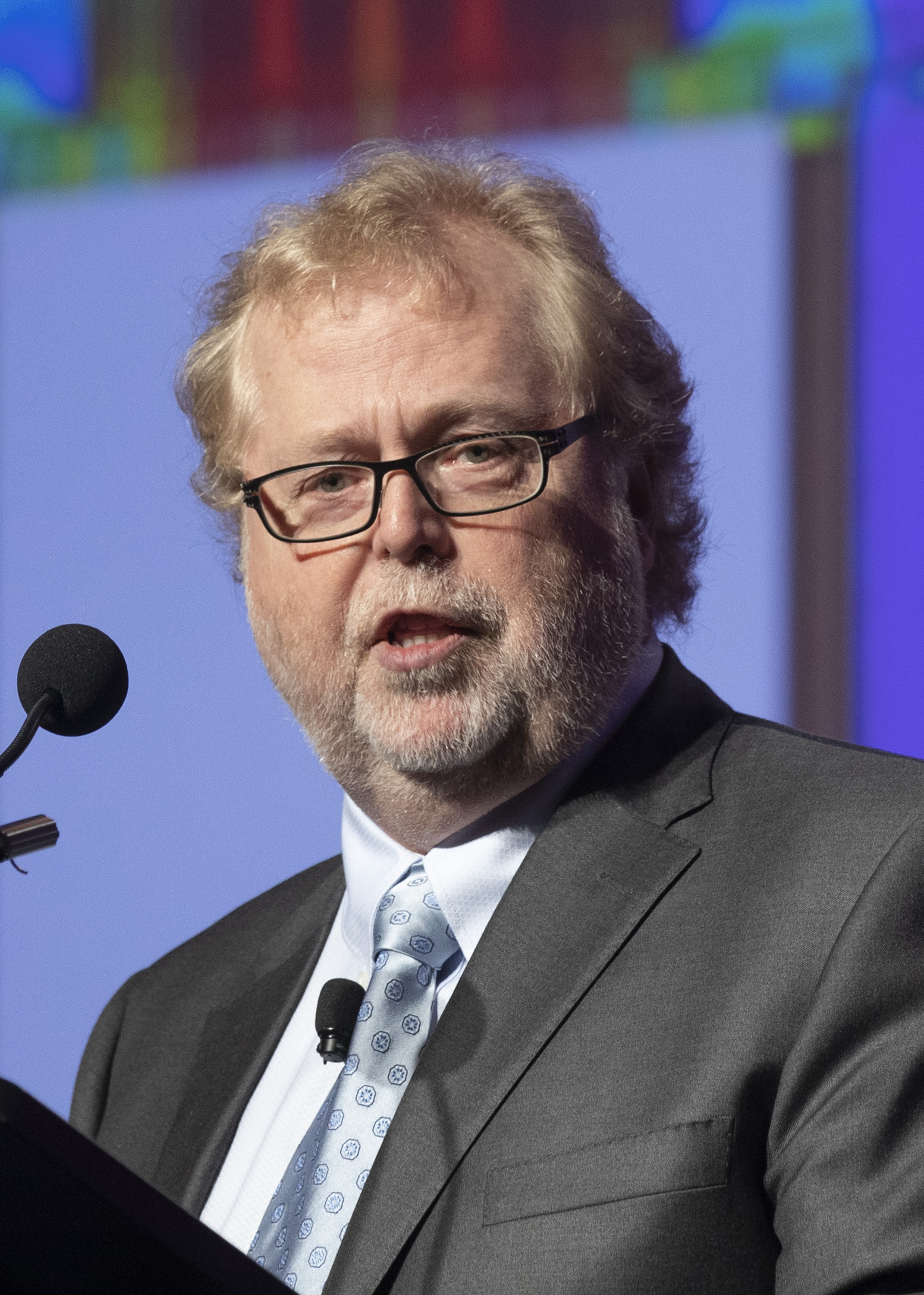


Image result for nathan myhrvold Nathan Myhrvold - Bill Gates described him as the smartest man he knew.
Taking ideas from one place and putting them in an entirely different context. He surrounds himself with influences.


"It's always better to be a critic than a creator." Nathan Myhrvold


Creativity is the interplay of billions of neurons sending trillions of impulses. Every experience you have is a raw material for your brain to create with and fashion into new ideas, by bending them into something new.

It's all about refashioning what already exists

Phill Tippett - Animator and Monster Maker.
He has a things and ideas room filled with "junk and stuff I've picked up over the years". He has organised it into an ideas generator. He randomly cut out pictures and put them into a book. He described the feeling of "I got it" when using them. It's an ability to put disparate information together and make something useful.

Robert Glasper - Musician
Jazz is a mashup of other forms of music. All of the forms of music that were around at the time was pulled together and reflects the time it was created in... it's always changing. If it stops changing then it's not following the tradition. If people of the previous generation are saying "You're not doing it right" then you are doing it right.


3 ways we can take advantage of how we are wired:

1. Try something new.

Being creative means fighting the instinct of not choosing the path of least resistance. Our brains naturally default to what we've done before. We need to dig deeper and get off that path of least resistance and try something new. For adults, this often translates as a career change. I've heard of the idea of getting kids to generate the first 3 ideas that spring to mind, then drawing a line under them and saying "You can't use this." Specialisation can mean 'learning a lot about less' can transpire into 'knowing a lot about nothing'. To be able to think outside the box you have to be willing to be wrong. You also have to be willing to be right when everyone thinks you are wrong.

2. We have to push boundaries. 

Our brains are novelty seekers. There's a fine line between exploring the range of possibilities between the familiar and the unfamiliar. Being willing to turn your back on traditional unwritten rules and test ideas that might be considered "wrong". Things that are considered "weird" are things that people are unfamiliar with. If it is considered weird than it is pushing boundaries. There's a spectrum between too familiar and too far out and wacky... its the in-between that is where the magic happens. tp create something that's not too new too unfamiliar but something in between.

3. We need to risk failing. 

Failure feels awful so we avoid it. The reality is that most peoples successes arise out of the ashes of their failings. Game of Thrones co-creator and writer, D.B. Weiss describes himself as failing very consistently for a very long time. He learned to be less worried about failing. All of the failures ultimately contributed to him being able to do this thing.

A school transforms...

10 years ago a Vermont School was on the verge of being shut down. Poor community. Terrible test scores. H O Wheeler. to save the school they decided to put creativity and the arts at the heart of every subject
When can kids learn? When they're engaged. - Bobby Riley (Principal)
When you focus on the arts and the process of the artistic experience, then they are able to blossom in unique and very special ways.
Learning geometry through the medium of abstract art. When it is integrated it hits more avenues that different learners use to access information. With creativity at the heart of every subject, the kids are learning a creative mindset. They're being taught to get off the path of least resistance and keep trying. It's about teaching them to try their best and to take a risk. It's about developing the process that allows them to interact with the world around them.

To succeed in an unimaginable future we need to instil creativity in our the children we teach so they can be successful in navigating that world.

How can we instil more creativity in our akonga?


Monday, 9 September 2019

Empowering: Learners & Teachers... and Me!

Connecting with Manaiakalani

We had the fabulous privilege to have Dorothy Burt leading us today. I always find that her perspective serves as a bit of a recharge.

Empowered

Learners and Teachers

Each of the 11 Manaiakalani communities has there own "why".
It began with the word "agency"... but that doesn't work within some of our communities, as the agencies that whanau are used to equate to various government Agencies... which equate to also turning their life upside down. Whanau interpretation is more important than ours.


It's important to not slip into a deficit model when talking about our communities. Despite the housing shortages and financial difficulties. Despite the outside influences that are impacting and adding stress.

5+ a day

Creating a dialogue with our kids, to develop their oral language, by bouncing the conversation backwards and forwards 5+ times. (Just like we want to create a thread with our blogging). This is a great strategy to combat the low oral language that our akonga arrive at our door with. By having deliberate conversations with the children we are effecting change in a positive way for them.

Google Forms

We went through a Chalk n talk to create a Google Form. It was great to be forced into amping up the use of it, rather than sticking to the tried and true. We created pathways etc, which was good to actually get stuck in and done.

Google My Maps

I'd never seen or used this before. pins can be dropped on actual maps, then pathways can by mapped, with distances measured etc.


Could use it at the beginning of the year to get kids to locate where they're from. Houses or countries.

Google Sheets

Protecting cells
Super Sheets! Using the Explore tool to work for you, creating graphs etc.

Tips & Tricks

  • You can freeze more than one row by selecting the row first and then freeze up to row.... You can also "grab" the grey line and drag it to where to freeze to.
  • Resize columns by highlighting the range. Then go to the top... double click on the blue line that appears. It'll allocate width due to length of word.

Getting Creative with Google Sheets

  • Split name Add-on... when you have both names in one cell, you can split them into two columns (first and last names)
  • Crop sheet Add on - to delete all the extra blank cells in a sheet, so that focus is drawn to what you're dealing with.
  • Filtering for effective workflow and saving to utilise them
  • Conditional formatting
  • SPARKLINE adds a visual line to
  • Macro Recorder... formatting a sheet and recording that, so that you can apply the same formatting to another sheet.

Students carry out a statistical inquiry about their blog.

Open a spreadsheet and gather some data.

What opportunities/provocations are there for 2020?

  • Who would benefit from doing the DFI next year? 
    • Whoever is new to the Takitini Team!
    • Whakatau Leader, to ensure that the pedagogy is embedded within the Whakatau team.
  • To quote Brene Brown... I need to step into the arena! 
    • I'm interested in applying for Google Class on Air for next year.
    • I want to consolidate some of the systems that hav'nt been working and have them more efficient to hit the ground running. 
  • Amp up creativity.

Monday, 26 February 2018

Learn Create Share... in numbers

To kick off the year we came together to improve our collective understanding of our Manaiakalani pedagogy 'Learn Create Share'. 

Six of our seven Outreach schools were present, with approximately 115 teachers plus Uru Mānuka Trustees (Garry Moore, Jason Marsden, Rose Crossland and Jane Ross) and Manaiakalani Education Trust (MET) Chair Pat Snedden.


Pat Snedden described the historical background that drove the Manaiakalani pedagogy's inception. We need to lose the deficit thinking...
He held the room spell bound as he gave insight into our obligations to right the wrongs of the past and break down barriers which have been inadvertently imposed over generations.

As one of our Uru Manuka Cluster Leaders of Learning, I spoke about how Learn Create Share has changed my practice:

Kia ora koutou. Ko Mel Raisin taku ingoa. Ko Ara tu Whakata (Gilberthorpe) toku kura.

Adapting my practice to follow Learn Create Share pedagogy has reawakened my excitement in education.

I’m acutely aware that I may run the risk of either preaching to the converted or prompting minds to close, however I want to begin with a provocative challenge in thinking.
Must Do’s/May Do’s; Task Boards or to do lists for learning tasks… We’ve all used them in some capacity within our learning environment.
Are we wanting our students to be busy with a number of superficial tasks via machine gun learning, by asking them to complete a large number of learning tasks whereby there is bound to be some form of learning “somewhere”.
OR
Do we want learners to develop an in depth understanding about a context where they have been required to draw information from a variety of sources; critically reflect, question and discuss their interpretations, seeking to synthesise and test theories and so on. Finally, share their learning in an appropriate and purposeful way to an authentic audience for the purpose of gaining feedback and feedforward that they actually want to act upon.
What I have discussed could fall under literacy, numeracy, topic… Actually… it could describe our own research, planning or teaching as inquiry.

Adopting Learn Create Share pedagogy has changed my practise in that there is a focus on depth of learning and understanding rather than quantity of completion. I strive to look for ways to make learning fun, like I believe it can and should be, or what’s the point?

There is a misguided perception that changing practise to align more with Learn Create Share pedagogy means increased teacher workload.

Every person in this room has access to a resource bank containing a wealth of DIgital Learning Objects, context based texts at every level. This gives everyone a place to start, regardless of where they are at on their journey. The idea being that the resources can provide a scaffold for teachers to modify to fit their own needs, then add their own to the bank for others to access and utilise. The collaborative partnerships between our Uru Manuka schools epitomises the rationale behind communities of learning before they even became a thing. Teachers being open to sharing makes teaching and learning smarter and more time effective. For me it’s a no brainer.
We’re not talking about throwing the baby out with the bathwater. But we do need to remind ourselves why the baby is actually in the bath.

Defaulting to a digital platform doesn’t replace effective teaching practices, which is an outsiders misinformed critique. Instead, it successfully supports them by optimising teaching time and minimising frustrating interruptions to re explain, reiterate and redefine a task. Learners can engage with content ubiquitously, the number of times and at the speed which best suits their needs at the time. I wonder what Vygotsky would have made of modern scaffolding.
The akonga are afforded an element of choice, (please note, choice doesn’t mean open season, but a few guided appropriate options)this increases potential for engagement and experimentation. Learners can individualise their learning experience to a certain degree, while working within set parameters.
Digital learning allows for the use of tools to break down barriers such as specific learning difficulties. Leveraging allows akonga to be exposed to content they are often excluded from as it’s deemed too hard.
Often our at risk of underachieving learners are unwittingly blocked from accessing curriculum by us, through our own best intentions and inadvertently placed glass ceilings.

There’s huge value of setting authentic purposeful tasks, whereby the learner understands the point or the why. Embedding a mindset where our young people are seeking a meaningful audience which is hopefully not passive, and gives honest helpful productive feedback. In our modern era, blogging is an invaluable tool for educating our young people to be safer cybersmart citizens. We’re needing to prepare them to deal with perils that social media platforms have that most of us never had to worry about throughout our mistake making years.

In a nutshell, I believe that Learn Create Share pedagogy enables my learners to be better equipped to be prepared for a future beyond our imagining.

We were placed into groups, consisting of a mixture of year levels and schools. We were then allocated either Learn, Create or Share and asked to define what that was. 
Our group chose, rather than to group ideas or cluster them, to draw a double koru to depict the pre-existing knowledge and the new learning to come. 
One of the frustrations that cropped up for many of us Leaders of Learning was that we had spent a great deal of learning around the Manaiakalani definitions of Learn Create and Share. The actual definitions weren't mentions or acknowledged. In many instances, groups had paraphrased stating "Learning is..." rather than "Learn is". This is a common misconception as it places a dictionary definition around Learn which centres on Learning as a Verb, which is far removed from the Manaiakalani definition.
There is a real fear that the baby may be thrown out with the bathwater purely because of the ignorance, albeit unintentional, of many. 
The Manaiakalani definitions are what they are due to a great deal of research, data and trial and error. They are what they are due to more than ten years of nitty gritty analysis. I feel it would be extremely arrogant (and ignorant) for us as a cluster to deviate from it due to a lack of understanding by members.
Time will tell what comes of it... 


We finished off our session with a powerful impromptu performance of Smash Poetry by Daisy Lavea-Timo.


You can read reflections on the day from Gary Roberts, Principal at Hornby Primary School, here
You can read reflections on the day from Robin Sutton, Principal at Hornby High School, here

Tuesday, 26 September 2017

Designing and implementing Change ideas, with NoTosh

So, this hit my Facebook feed this morning. I duly saved it, along with the screeds of other "Saved Stories" that sit in limbo until time (Or holidays) afford them attention. A sick son intervened today, so I was able to afford it the attention it had been seeking... The immense productivity that can be achieved on a "sick day" is cause for far more in depth self assessment and a further blog post!

I have been a fan of NoTosh since having the pleasure of professioanl development around Design Thinking, as well as attending 2 ULearn Confernce Worshops around it in 2014. I really identify with the lens that they view education through.
This video has some great quotes along these lines:

"Education is about evolution. If you're not changing, what are you doing?"


Speed of Change:

The speed of change is often bandied about as an excuse to place a boulder in the water. I challenge that, when that overwhelming sensation begins to set in, when there is so much going on all at once... Perhaps we just need to take a step back. Change the lens that we are viewing through... Think of the changes we are implementing as "prototyping".  
Some people are quick to adapt a mindset where they view the amount of changes taking place in education as "treating our åkonga like guinea pigs". We want our children to learn to test theories and make mistakes and then learn from them... Why are we afraid to do this as teachers. We are no longer the keeper of knowledge that we were, even just twenty years ago. We are no longer delivering education from the front and centre of the room. 

This video prompted me towards a number of considerations, which are very topical at the moment. We have been in our new space just a few weeks, heading into the holidays. We have the luxury of a term where we can begin to set some key objectives for the term. We often set objectives for what we want the students to achieve... but why not what WE want to achieve, in terms of pedagogy and practise.

If you are making structural changes, you are making pedagogical changes.

  • What are the "Pain Points"?
    • If you are making structural changes, you are making pedagogical changes.
"If you're making structural changes, you're making pedagogical changes." Teaching in post quake Christchurch, has enabled a transformation of learning environments. The schools who have been fortunate enough to front-load the transition with developing the pedagogy have, I believe, been far more successful in implementing change. So many changes have taken place, all in one hit. Those who have been fortunate enough to view it with a "prototype" mindset, who have perhaps been more open to adapting to change, have been far more successful in the way structural change has occurred. There is some fantastic stuff going on down here, in little ol' Christchurch New Zealand. Flexible bell times; play first, eat last initiatives; modifications toward ILE or MLE or whatever we want to call it next week... Most of these schools are sharing their journey too!

Prototype Culture

Heading towards planning for Term 4, I prototype mindset makes logical sense as a lens for mapping out what needs to be covered: Curriculum coverage; AO's; Topic/strands etc... The ability to map out when this "might" happen in terms of timetable or term plan... Stressing the word "MIGHT"! By mapping things out... Prototyping, it gives clarity on what the outlook is, providing frameworks for all teachers to work within. We all need fences sometimes. Some who get intimidated by change or new thinking ideas etc, are made more comfortable by knowing the perimeters that they are working within... Some of us, probably need the framework to minimise the tangents and keep us on the same track as everyone else (Which probably helps everyones ability to cope with us and our foibles too!)

Incubator

"What do we want to change and let's change it."
Set key objectives for Term four.
  • What do we want to achieve in terms of Teaching and Learning?
    • Prototyping Teaching Approaches?
    • Developing Student Voice?
    • Assessment Capability?
    • Shaking up the programme?

Wednesday, 20 September 2017

Uru Månuka Student Summit

Twelve Gilberthorpe students were privileged to attend the first inaugural Uru Månuka Student Summit, at Hornby Primary today. 6 students presented Toolkits to other åkonga in pairs. 
They attended (and presented) Toolkits on topics ranging from robotics, voki, scratch coding, using apps... 
Afterwards, the 90 students were able to take their new knowledge back and share it with the åkonga in their classrooms.


You can read our earlier posts about the Student Summit here.

Tuesday, 19 September 2017

Unpacking Learn Create Share in a way thats not so scary

Recently, I ran a staff meeting around Learn Create Share.
Ironically, it was the first staff meeting that I'd attended since joining my new school. The upside to this was that there was no precedent to follow... No pre-existing notion of what it "should" look like.
Here's the basic presentation to guide the discussion:

We looked at each definition, without the "Learn" "Create" or "Share" attached to it, in order to ensure that we weren't overthinking it. 
Within our cluster, our Uru Manuka Leaders of Learning PLG has identified that we do have a shared understanding of what Learn Create Share is... it just differs slightly from what it should be, by the Manaiakalani definition. After much robust discussion, we came to the conclusion that the initial definition was accurate and we needed to align our own understandings with it. After all, the immense research that has gone into the concept backs it up... who are we to question it through our own ignorance!

What next... How on Earth were we to take this eye opener back to our schools!
We were all in agreement that going back and telling our colleagues that everything we had thought about what Learn Create Share was wrong (after two and a half years of building that pedagogy, I might add...) was not an appealing option.
My approach, was to utilise the feelig that I had that everyone was doing a lot of things already, but they didn't understand how their great practise actually aligned within Learn Create Share.
I decided to take each definition and put it to the teachers: 
What happens in your hub that falls under this heading?

We compiled our ideas onto large sheets, using post-it notes...
Here's what we came up with... Compiled into a piktochart Infographic:

My next step is to align my Critical Inquiry etc, with a lens that accommodates a Learn Create Share view, from a teachers perspective also:


Tuesday, 25 October 2016

A School Visit with our Neighbours

Visiting Our Neighbours

Last term, Kelsey and I visited Simon and Kate from Hornby Primary to have a look at how they organise, implement and assess Literacy.  We were also interested to look at how they organise their programme and manage their work load.  
Here are some of the observations and points from our discussion:

*Kate takes Reading, Simon takes Writing.  This is done for the entire year.  The teacher of the subject area is the go to person for parents. 
*The hub works in a space that was once the Library and has two main spaces with a walk through area between.  
*During Writing, Simon works with a group while others work on Spelling City, comment on blogs or free write.  
*Students use their Google Site to navigate and access their learning.  I had the pleasure of being talked through student learning and agency by a lovely student Siola.  
Check out her blog here.

Reading taken by Kate.  Kate uses a TV screen to share learning with her instructional Reading groups.
I didn't see much of the Reading or how the changeover from Reading to Writing worked so I will check in and see how they do this.

*Each writing group has a collaborative, online modelling book.  This is where they can work on whatever the writing focus is and create their own pieces of writing on the same doc.  For me this looked like an easy way to have access to a a whole groups writing, in one place.

*One use of Google Forms that I thought was a great idea and one that I have not yet implemented, is where students receive a form with a video clip.  The form then contains questions for children to answer around what they have seen.  This can be used as pre assessment and also for planning where to go to with writing.  This is another way to have instant and easy to access data.  

Whaea Heather's Room-Bilingual Class

*We spent a little time in the senior bilingual class which was lovely to be in.  
*Heather and her tamariki were working on a doc which had been shared and copied.  Students shared ideas on a Padlet and when individuals were writing, the ideas bank was visible for all to see and use.  They then formulate their writing on their own doc and have sharing moments as they go.  Feedback is more oral.  
Children in the bilingual class choose where to work.

Question time-

We had the opportunity to spend time with Simon and Kate to ask any questions.  Some of these questions were around the learning programme and some were about managing work load and what systems were in place. 

These are the main points that resonated with me:
*A limit with blog commenting is one blog comment per week per child. 
*Feedback given during writing is more in instructional sessions.  Sometimes typed sometimes not.  
*Resources...set up of modelling book takes about 40 minutes for 2 weeks.  
*Use class time to make comments.  
*Part of writing is that some children comment and give feedback.  
*In class data gathering...Google forms...No tracking sheets or anecdotal notes made as these are done mainly via individual blogs.
*School wide documents that need working on are limited.  One class profile created in term one and updated in term two, Teaching Inquiry and appraisal.
*Simon is released one day a week to support junior school with Learn, Create, Share and support children moving through to the Year 5 and 6 end of the school with transition.

It is always helpful to visit other classes and see how people are doing things.  We both really appreciated being able to have the time to discuss and share ideas.  A worthwhile visit indeed.


Monday, 27 June 2016

Learning from Eachother

Senior Hub Visits the Junior Hub


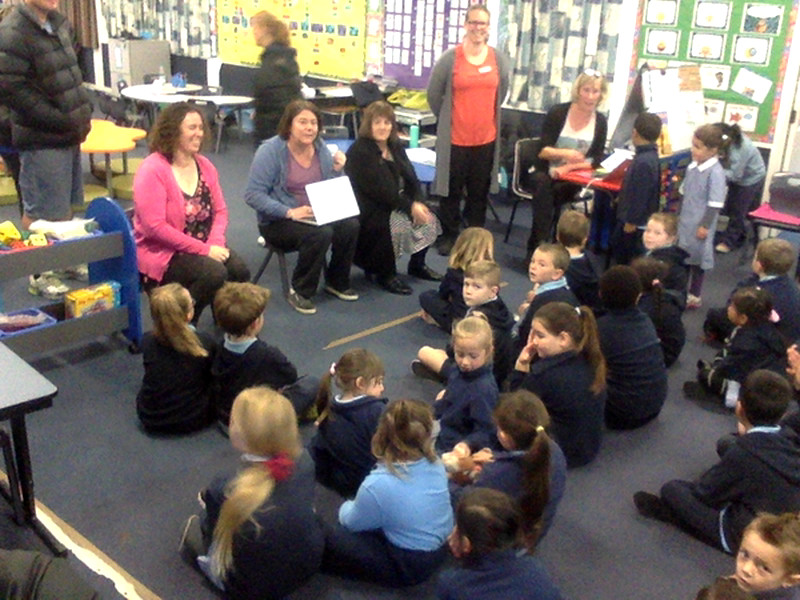
We are now teaching in two significant hubs, being junior and senior.  With the move of the Years 0-3 students being moved to the open space within the hall, the senior school teachers have felt the need to understand what is happening within the junior hub and gain some understanding of programmes and structures in place.  

We see this as being important so we know what students have been learning and can make connections for when they come to the senior hub.  It is also good to have consistency across the school and will help develop our learning programmes.

For all of us, this visit was very positive and informative.  We were able to see the beginning of the day routine, Numeracy and Writing.  We are intending to visit again in term 3 as three interns were teaching so we need to see how things are managed when just the four teachers present.  
Here are a few snippets from what we observed:

Jun 23, 2016 9:00:49 AM.jpg
Teachers situated in different parts of the room.  One child chosen for karakia.  One student says the first line and hub repeats.  Hub then sings waiata Ko Mātou.  Sounds so lovely.
Jun 23, 2016 9:16:12 AM.jpg
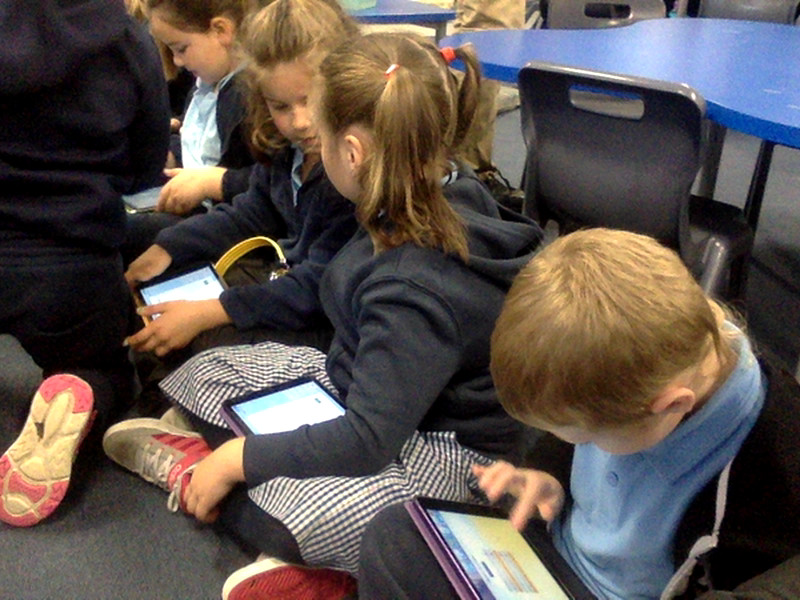
Children work independently one to one on iPads with Mathletics.  Children are still in the learning stage so are working out what to do with some activities.  Some swapped and asked each other for answers.  
Jun 23, 2016 9:14:00 AM.jpg
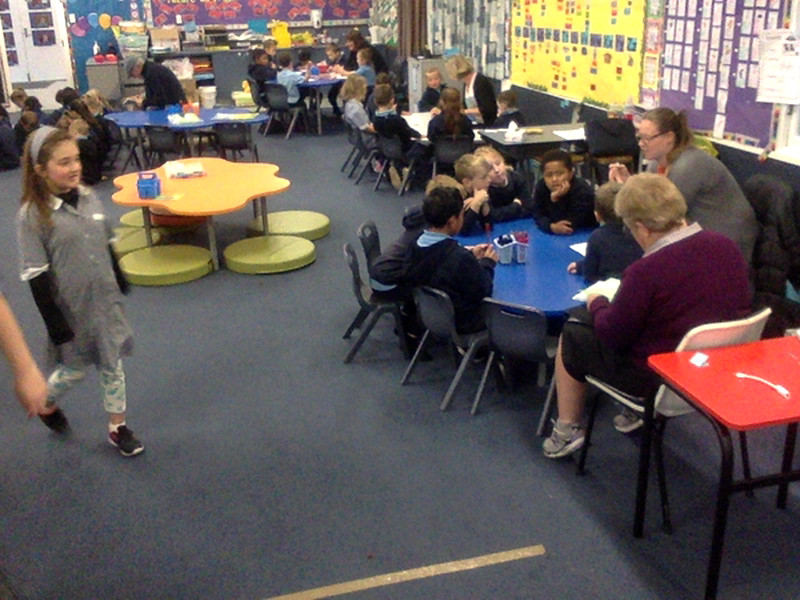
All instructional groups had a high level of engagement.  These are not currently indicative of how the hub normally operates as there are currently three extra people.  Average of 6 kids per group.  Follow up type work is done at the instructional group.

Actions stations are levelled at three different levels. Activities include:  Peg boards to develop fine motor skills and making patterns, missing number whiteboard sheets, forming numbers.  A buzzer goes and children move to their next station.  Some move to a mat area and then a teacher directs them where to go.  As they change fortnightly, as groups change and teacher role changes.
Some students working on the mat using text books.  Setting out of books is being put in place and some are neater than seniors.  This is deliberate in getting students ready for senior school expectations.

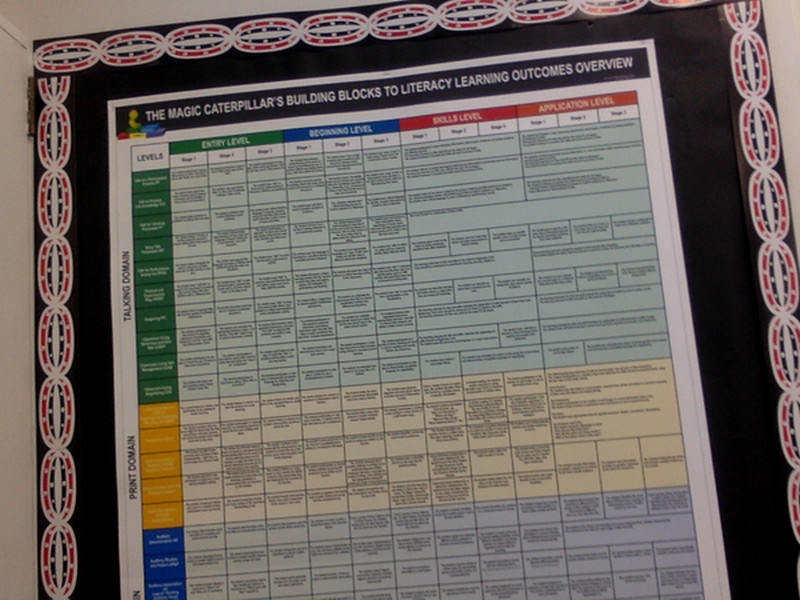
Building Blocks- This is significant for us as we are looking at implementing some aspects of this programme to help tend to needs of out senior school learners.
Jun 23, 2016 8:55:18 AM.jpg
A mammoth chart of skills needed to be curriculum ready.  Action stations are designed to develop these skills.  Domains are focussed on each term.  These include Talking, Print, Listening, Looking, Moving.

Where to next?
Our next step in understanding and working collaboratively across the school, will be for the junior teachers to visit the senior hub and for us to visit the juniors again and look specifically at how literacy is covered and organised.

Hornby Cluster

Hornby Cluster Schools Get Together


Today the Hornby Cluster Schools gathered at Hornby High to hear Pat Sneddon, the chairperson of Manaiakalani speak and share the story of the Manaiakalani journey.  
Brief explanation of what Manaiakalani is:
In 2007 our initial cluster of schools wanted to find a way to engage the children in our mostly Decile 1A community in their learning. Digital Learning proved to be the ‘hook’ to guide our whole community to better educational outcomes.
Some of the crowd ready to get into it.

Pat began with sharing how the Manaikalani Journey began and took us through to where it is now and where it is going.  He shared stories about the Tamaki area and how the need for liberation of the low income learner emerged. One concept from stories of the time was around Rangatiratanga, taking charge of your own circumstances.  The tangi of Te Arikinui Dame Te Ātairangikaahu led to thinking about how we can be as good at educating the living, as we are at burying the dead?

The Tamaki Transformation Programme which included  Glen Innes, Panmure and Pt England, identified that the infrastructure had many issues and the area had a number of things that were not right.  A group was put together made up of government, community groups etc. who looked at infrastructure and what was working well. 

In 2009, Principal of Pt England School and Manaiakalani Convenor Russel Burt, invited Pat to visit his school.  He was greeted by children who then told him about their learning. They shared about how they were beginning to learn digitally.  It seemed too good to be true as the learning taking place was astounding.

Some reasons for everybody not being involved at the time, included issues such as cost of retraining teachers from an analogue to a digital world and finance.  Pat's response was if I get it for you would you come?  He did, they came and here we are.

Pat shared this video from Russell Burt which looks at moving from subsistent living to capital building by design.   Move out of subsistence to capital building.  This is significant as this is part of the purpose and goal for Manaiakalani schools.

Stuart McNaughton and Wolf Fischer Research-significant research has and continues to take place within Manaiakalani and outreach cluster schools.  Click here to read research findings to date.

We are part of five clusters across the country.  These include schools in the West Coast, Papakura, Mt Roskill and Kaikohe. Thirty eight schools across New Zealand are currently on the journey to use digital technology to accelerate learning for their students.  

We need to know what we are trying to achieve with being part of this outreach.  
Collaboration across schools and boards is essential.  Some things that have been put in place such as wireless in homes, could not have been done without collectivity.  

Within this process, opportunities for creativity and collaboration are abundant.  Positive for teachers to be able to learn from each other.  Learning is visible.  

Initiatives to support and develop teacher capabilities:
*innovative teacher
*digital teacher academy  
This process is built on this structure:
Whanaungatanga-Relationships

Kaupapa-Purpose

Putea-Resources

Where to next?  Outreach+ is the outreach programme being made available to all New Zealand decile 1-2 schools.  Our performance as leaders and teachers counts.  We need to be able to prove the case that what we are doing is working and we are achieving our goals. 
Key focus: 
What happens to and for the learner?
We can't do this alone...so we collaborate.
Hornby Cluster Schools...a positive start and well into this new journey.

Wednesday, 13 April 2016

Getting it Right

A reminder of what our foundation needs to be built on...

When we visited Waitakiri School, there were certain visuals that were presented that show the importance of getting what we as teachers do, right.  We have said all along that the teaching pedagogy or the method or practice of what we do is the most important.

As we move along in our continuing journey of progress, development and change, there are many factors that we are developing and trying to implement to best serve our learners.  We have changes in our buildings, increased use of technology and working in teams of teachers in a shared environment.  

These visuals remind us of how things can work out depending on what we have as a foundation.
Technology is a tool to help learning, not be the only means to learning.
The physical environment does not create or promote outcomes on it's own.  It serves as another way to maximise learning.
Collaborative teaching on it's own may not work in isolation.
If we fail to do any of these things well, we will create chaos.
When we have a foundation based of effective teaching strategies, our learning is student focussed and our teaching teams work effectively together, we are better equipped to integrate technology and other resources and work within flexible learning spaces to competently do what we are all here to do...improve learning outcomes for all students and keep our school vision alive.

On the pathway for success, growing confident, collaborative, lifelong learners in an ever changing world.