Gilberthorpe school

Gilberthorpe school
Showing posts with label Wellbeing. Show all posts

Friday, 13 December 2019

The Creative Brain

What's a Saturday morning with no sport... Netflix has provided! Check out the preview:
This morning I fell upon THE CREATIVE BRAIN. It promised to take audiences on a journey with neuroscientist and best-selling author, David Eagleman, to meet accomplished professionals from across the creative spectrum, unravel the creative process, and encourage all of us to be more creative.

As teachers, it's crucial that we understand this concept. We are in the creative age (not the digital age, as some still believe). Creativity is a fundamental piece that our educational experiences are lacking. WFRC has been telling us this for the past few years, however I think teachers lack the understanding of what that means. It's not "creating", in the traditional sense.
Creativity is the ability to take on new information and put it together with what we already know.
Humans have transformed the world we live in like no other species. People often link creativity with the arts, however, it is so much more than that. To consider what doesn't exist. To rise above our instincts and consider our other options before deciding what to do.

Most animals have the input and output parts of the brain right next to each other, so there's a direct path between the two. There's an instant reaction. Not much happens in between. Our brains are wired differently, we are able to disengage our instinct to see it differently. Input can collide with what's already there to forge new pathways, make new connections... considering possibility based on what's already there. We can process information in limitless ways. The enlargement of the human cortex, the expansion of the prefrontal cortex behind the forehead... This gives us imagination.

Being original is not about generating something out of nothing

Michael Chabon - Novelist attempts to debunk the theory saying there never has been such a thing as a truly original idea. A Pulitzer Prize winner that's not afraid to take ideas from anywhere, he operates on a basis of instead of "how can I make mine different from my predecessors? How can I utilize what they did to make mine better?"

What we create is unique because our life experiences are unique.
It's about getting out into the world and generate new concepts. Take the ordinary and make them extraordinary by putting them in a yet unseen combination. The creative process often involves making something, yet it also has the power to remake our lives.

Ehron Tool - Potter. He was a Gulf War veteran. He came back with a notion to do something different with his life. His creative outlet allows him to create discussion, generate a feeling. It's become a real healing process.

Lafayette Correctional Centre runs a groundbreaking programme by writer Zachery Lazar. His father had been murdered and this impacted his entire life. Upon visiting a correctional facility as a journalist he realised something surprising. He was surprised by a connection he felt to a lot of the people he talked to. He felt that there was a real lack of creativity in the prison. He felt that by harnessing those people's creativity, it could be a way of preventing them from being in the prison cycle. He now works with the prisoners to nurture their creative writing skills. The impact has been described as helping them think differently about things, think differently about themselves and think differently about other people. They are able to see themselves. It's about changing the narrative.
Tim Robbins (of Shawshank Redemption fame) runs acting workshops with prisoners. Often prisoners are defined by their mistakes made and any potential is never considered. By telling them that they are defined by who they are as human beings. The emotions that they suppress are real emotions. Prisoners taking part in these programmes are up to 80% less likely to re-offend.


Michelle Khine of Shrink Nanotechnologies, combined her childhood experience with Shrinkydinks and utilised it to advance science, by creating the tools she needed.
In order to advance science, you need to think about things in a different way otherwise nothing changes.


Bjarke Ingels is a Danish architect renowned for his imaginative designs. He operates by using a lot of material on hand to mash it with what is in his imagination. We have the power to imagine a world that isn't our world yet.

He blended his idea of lego with preconceived notions of a house. A ski field with perceptions of a building.



Image result for nathan myhrvold Nathan Myhrvold - Bill Gates described him as the smartest man he knew.
Taking ideas from one place and putting them in an entirely different context. He surrounds himself with influences.


"It's always better to be a critic than a creator." Nathan Myhrvold


Creativity is the interplay of billions of neurons sending trillions of impulses. Every experience you have is a raw material for your brain to create with and fashion into new ideas, by bending them into something new.

It's all about refashioning what already exists

Phill Tippett - Animator and Monster Maker.
He has a things and ideas room filled with "junk and stuff I've picked up over the years". He has organised it into an ideas generator. He randomly cut out pictures and put them into a book. He described the feeling of "I got it" when using them. It's an ability to put disparate information together and make something useful.

Robert Glasper - Musician
Jazz is a mashup of other forms of music. All of the forms of music that were around at the time was pulled together and reflects the time it was created in... it's always changing. If it stops changing then it's not following the tradition. If people of the previous generation are saying "You're not doing it right" then you are doing it right.


3 ways we can take advantage of how we are wired:

1. Try something new.

Being creative means fighting the instinct of not choosing the path of least resistance. Our brains naturally default to what we've done before. We need to dig deeper and get off that path of least resistance and try something new. For adults, this often translates as a career change. I've heard of the idea of getting kids to generate the first 3 ideas that spring to mind, then drawing a line under them and saying "You can't use this." Specialisation can mean 'learning a lot about less' can transpire into 'knowing a lot about nothing'. To be able to think outside the box you have to be willing to be wrong. You also have to be willing to be right when everyone thinks you are wrong.

2. We have to push boundaries. 

Our brains are novelty seekers. There's a fine line between exploring the range of possibilities between the familiar and the unfamiliar. Being willing to turn your back on traditional unwritten rules and test ideas that might be considered "wrong". Things that are considered "weird" are things that people are unfamiliar with. If it is considered weird than it is pushing boundaries. There's a spectrum between too familiar and too far out and wacky... its the in-between that is where the magic happens. tp create something that's not too new too unfamiliar but something in between.

3. We need to risk failing. 

Failure feels awful so we avoid it. The reality is that most peoples successes arise out of the ashes of their failings. Game of Thrones co-creator and writer, D.B. Weiss describes himself as failing very consistently for a very long time. He learned to be less worried about failing. All of the failures ultimately contributed to him being able to do this thing.

A school transforms...

10 years ago a Vermont School was on the verge of being shut down. Poor community. Terrible test scores. H O Wheeler. to save the school they decided to put creativity and the arts at the heart of every subject
When can kids learn? When they're engaged. - Bobby Riley (Principal)
When you focus on the arts and the process of the artistic experience, then they are able to blossom in unique and very special ways.
Learning geometry through the medium of abstract art. When it is integrated it hits more avenues that different learners use to access information. With creativity at the heart of every subject, the kids are learning a creative mindset. They're being taught to get off the path of least resistance and keep trying. It's about teaching them to try their best and to take a risk. It's about developing the process that allows them to interact with the world around them.

To succeed in an unimaginable future we need to instil creativity in our the children we teach so they can be successful in navigating that world.

How can we instil more creativity in our akonga?


Thursday, 11 April 2019

Penny for Positive Education Conference 2019

Positive Education New Zealand Conference  - Wellbeing

Penny Osborne
April 2019


I have just attended the two day Positive Education conference on Wellbeing. Barista coffee was flowing for the hordes of people that had travelled around the country to be here at

Christ College with us. This was such a humbling sight after the recent events in ChCh.

I found most of this conference was based around how to incorporate wellbeing into your teaching and embedding it into your classroom, as a non teaching support staff member, I tried to take the most out of it I could, overall I enjoyed it and felt I got some goodness out of it.

Positive education in NZ, the welcome was simple - We need to look after our own wellbeing to care for and teach our tamariki and rangatahi.

We started the day with Charlie Scudamore Vice Principal from Geelong Grammar school, a very passionate and educated man. Charlie has been responsible for the development and implementation of Positive Education at Geelong and travels to conferences promoting the Positive Education model. What is Positive Education? Based on science and research blah blah.. Positive Education sounds great and appears to be working, but I wasn’t there to learn about that, I was there for what I thought was understanding wellbeing, for yourself, your colleagues, your students, everyone that comes into or is in engaged in your school. The staff, the students, the whanau, the BoT..

Charlie is a wonderful speaker and would highly recommend if you ever got the chance to listen to him, do it! This is what I took away from his discussion

Instead of looking at what went well, try what went wrong! You might surprise yourself

Learn it, Live it, Teach it, Embed it

Do wellbeing with the students, not to them or for them. Wellbeing is something that needs to be learned, learn to be comfortable and understand your own well being

Staff, train the staff, all staff but don’t over train them, by doing this you are acknowledging every interaction matters and that non teaching staff play a critical role.( I have seen first hand one of our students, not liking being in class, found the caretaker and was engaged in some gardening with him. The caretaker became the teacher, showing him what were weeds and what the different plants were. The student was asking the caretaker questions about gardens and growing plants, this may not be huge, but to that child, that is how he learned for a part of that day.) 


The Six dimensions of Wellbeing


Positive Relationships - Connectedness and strong relationships for wellbeing. Focus on developing social and emotional skills. Strong school community and culture of respect. kindness and forgiveness.

Positive Emotions - Aiming to help students and staff to develop a stronger understanding of their emotions and those of others.

Positive Health - The link between physical and psychological health. Practising mindfulness and resilience techniques will promote greater health outcomes. Learning or knowing healthy behaviours in terms of exercise, nutrition, and sleep.

Positive Engagement - Finding passions and interests to keep you engaged, being present in what is happening around you.

Positive Accomplishment - encouraging both students and staff to aim for goals that are both highly rewarding to them self, aim high, show determination, and be willing to learn and succeed.

Positive Purpose - Explore understanding, believing in yourself, and deliberately engaging.

Age of Anxiety


Anxiety is on the rise and is a big factor in wellbeing, some strategies for helping yourself or others cope with anxiety.


Grounding - an effective rewiring of the brain (countdown)

5. Notice five things you see around you

4. Notice four things you can touch around you

3. Notice three things you can hear

2. Notice two things you can smell

1. Notice one thing you can taste.


Relational

Understanding what is going on by ..

Reflective learning

Clarifying questions

Showing empathy

Disassociation

Safe space

Regular checks

Talk later

What can we do to help eliminate anxiety?

Empathise and be human

Remain curious and open

Build connections

We might not be able to change everything, but we can change how we respond to it.


Trust and believe you can help.

An emotional brain only learns through experience

Mental Health First Aid


Having the strategies to notice when somebody is struggling with wellbeing issues (mental health challenges)

Think about being in an airport where you have excess baggage, but no trolley to use. Your taxi is waiting and you need to get to that meeting..

You pick up the first bag, not to bad, you got this..

Pick up the second bag, that's a bit heavy but you have to get to that taxi

You pick up the 3rd bag, that's too much, you can’t carry on, but you know you have to, you can’t make the taxi driver ate, or let the meeting down..

STOP!! Know when to put a bag down, know when you need to go, actually bugger it I am going to make 2 trips because I am more important than that.

Mental distress is common

Mental distress can feel permanent

Recovery is always possible

Early intervention is key

Self Regulation - Nigel Latta


By far my favourite speaker of the conference and a wonderful way to end day one.

Nothing like keepin it simple to solve life's biggest problems. Although he did open this by showing a picture of him covered in spiders, as most of you know spiders are a genuine fear of mine. Nigel reckons, if you face your fear you will get over it.. I’m not so sure and will leave the finding out to another day.
Know how to: 

Recognise


Rebalance


Rewire


Your brain is a machine, but don’t always believe everything it tells you. Your brain is your biggest critic, the thing that holds you back the most.

When in doubt, chill the …. Out :)

Day two The critical factors in building whole school wellbeingFactors that appreciates and nurture wellbeing

Realising you are out of balance

Open communication

Having a chance to debrief and not let things fester

Knowing how to have a work/ life balance

Factors that challenge my wellbeing

Myself, I am my biggest critic

Lack of self motivation

Life / work / hobbies - the commitments of others around me

Factors I can influence/ change

Work / life balance

My health

The way I communicate with people

Celebrate the little things

School Wellbeing factors

Check in & Connect time

Be aware of colleagues and their needs

Move on from ‘Fitting in’ to “Make room for”

Make the staffroom more inclusive, acknowledge people daily, include people

Start the change now, Be Brave!

Creating a culture of wellbeing
A wellbeing team needs a purpose, a vision, a mission. You need to work together to develop these. Make it clear the wellbeing team cannot fix others wellbeing, they can provide the tools to help

Get the framework up and running before you push the go button.

Take notice of the needs of your environment, see where people are at with their wellbeing

Involve everyone, ask students what does it mean to be a Gilby kid? (BTB - Better than before)

Build staff relationships and get involved in events together

Make time for support staff to be involved in discussions or sometimes decisions.

Engage with the community, learn from them. Let them share their stories, we all have something to learn from others

We are all learners, we are all teachers.

I went to a couple of the open conversations, but was disheartened to learn that one titled - We’re all in this together - sounds good on paper, but in reality, that was not the case. The speaker started of with what she has done to get wellbeing off the ground in her school, sounding awesome and things I could see being discussed or implemented in our school, She then followed on with a sentence that irritated me.. ‘We do not yet have support staff in the wellbeing mix’, so really they weren’t all in this together.

At the end of the day, regardless of the title everyone should be involved and encouraged to learn it and live it. We all matter, we are all there for the same reason, those children that come to us everyday wanting to be nurtured, cared for, educated and to know they belong.

Saturday, 6 April 2019

NZCER Wellbeing @ School

Wellbeing at School Survey

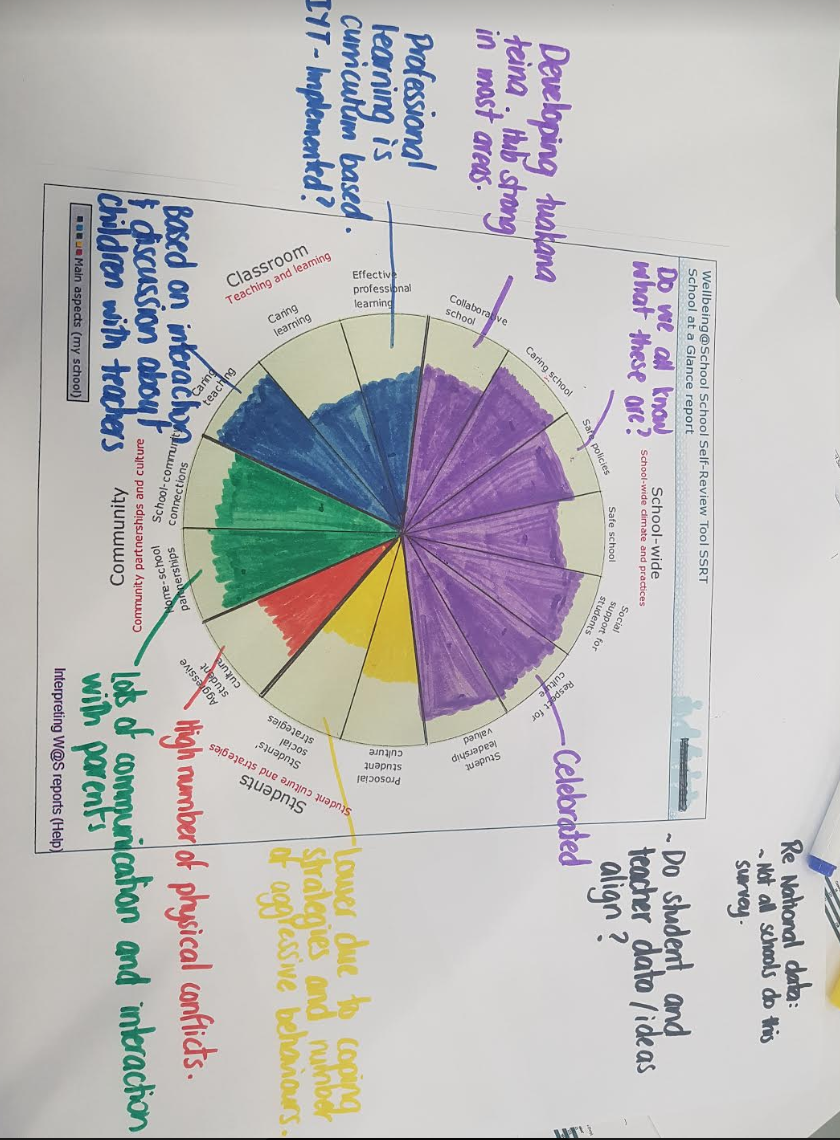
Last year I attended a Wellbeing at School workshop through Mana Ake.  It looked at the NZCER Wellbeing @ School Survey.  I have only just found my notes as I tidy up my Google Drive.  We will be doing the survey next term so these seem a little more relevant.
Wellbeing at School
28 August 2018
Somerfield School
Kathy Johnson
Purpose: To determine what the Wellbeing at School tool can offer and to challenge how we use it.
Main Messages:
  • This tool allows you to stop and take a look at what you have done and where you can go.  
  • Is a whole school approach.
  • Focuses on the school climate...the way people feel.  Culture is the way we do things, climate is how we feel.
  • If people feel they belong to a positive school climate, achievement outcomes improve.
  • There are three surveys in this, student, teacher, self review.
  • Looks in to see if what you are doing is working.
  • Lists what a positive school looks like.
  • Key Idea 1: Systems Thinking is increasingly being used as a lens to think about behaviour and schools.  What you might be trying to do, can be undone by somebody within the system.
  • Layers: School wide climate and practices, teaching and learning, community partnerships, pro-social student culture and strategies, aggressive student culture.  
  • Website is set up under these five layers.  Has templates and next step planning within.  Link to Wellbeing at School Website
  • When looking at data, use the scale descriptors alongside.  Descriptors are on the website and are crucial for when looking at data.
  • When you have done the survey, bring a self review team together.  Include the people who will implement policies and procedures. Often, the leadership team data differs from the student perception.  From perception, determines reality. This graph is the first thing you should look at.
  • Administration-student understanding.  Good to have the same person implement the survey, it’s ok to have a discussion around the questions.  Why the dissonance? How well do teachers know the learner? Have guiding focus questions. They should come from any initiatives you have undertaken this year.  Professional development, inquiry, appraisal goals. Use these to refine and drive what you are looking at in the data. Come up with statements that you hope to achieve.  
  • Teacher survey:  Could be done at a staff meeting as shows that it is valued.  Takes about 45 minutes. Raising awareness to why we would want to do this.  
  • The Aspect Report: When looking at graphs, stop and look at these to see if there are any cohorts that stand out.  You are interested in the cohort that stands out. Use the filters to check for trends. Remember we are looking at perceptions.  (Looked at an example where girls thought they were pro social, however, their aggression was high).
  • Two things under your control:  How we teach and how we organise our school.
  • Data is about improvement.  If there is no place to improve, there is no pint gathering data.  An inquiry question comes out of data. Then gather more data.
  • Be deliberate and purposeful in where you are heading?