Gilberthorpe school

Gilberthorpe school

Monday, 5 August 2019

DFI 3

Hanging out with Dorothy:

Create... Hanga - It's all about the HOOK!

  • How do we as teachers ramp it up in the classroom?


"The Lifelong Kindergarten Group" - A world of Playfully Creative People..."

  • This may be beneficial for our Te Ara Whakatau team to check out, particularly regarding Play-based learning?


The goal is to have no learner missing out on the opportunity to create within their learning journey.
It's time again to focus on Teacher Creativity. We need to be celebrating this within our Kura as well as wider.

The heART of the matter talks to the learners as adults as they describe what it was like to learn in this way.

It wasn't National Standards that killed it, it just slowly wilted away. Let's go back to it! Focus on the front half of the curriculum as well as the back half.

Exploring Create in the Manaiakalani Programme open doc. This is fascinating to look at, particularly after our own clusters journey to unpack what Learn, Create and Share actually mean. It's great being able to look at this knowing how many brains have pooled to create this shared understanding. It's also something that I feel we need to refer back to in order to continue to be on the same page.

This image, created by Karen Ferguson from Tamaki College, which sums up what it means to Create in our Manaiakalani pedagogy.


Manaiakalani Foundation goal: to "motivate our learners to engage with the curriculum"... Are our kids actually being encouraged and lured into engaging with the curriculum? Or are they being expected to engage?

We need our kids to be Creators of content. If they are not being challenged to engage, then they become consumers of content. Passively surfing the net etc. It's "learn, create, share", not "learn, go google, share". (Brilliant quote from Mark Maddren)

Purposely creating the opportunity for creativity and learning.


Often the learning hook starts with the opportunity to create, then they have to go away and do the learning.

We need to pull it back to the purpose:
Motivate our learners to ENGAGE with the curriculum

The 6 C's of education in the 21st Century.


Creativity is key. Nobody wants to employ somebody that just knows how to tap in to find existing info, they want employees that can generate ideas and thinking.

Ken Robertson was an actor before he was an activist in creativity.


SISOMO

Kevin Roberts from Saachi and Saachi (A Kiwi who was CEO Worldwide) Sight/Sound/Motion.
If you want people to buy-in you need to touch their hearts. To do that you need to use these 3 ingredients.  SISOMO creates innovation and imagination as well.

Cool Hacks

Slides - if you are stuck in "present" mode, you can delete the end of the url to see the speaker notes. Likewise, if you are sharing something, put "/copy" on the end and it will force them to make a copy.

Multi Modal

Engaging "The Hook"

Our challenge is that our learners are immersed in a world where everything around them is competing to engage them and we have to be able to hook them in the same way. We need to hook our kids in, at the beginning, so that they think "Oh wow, I really want to get into this". Pt England use Immersion Assembly's to hook their learners. 

Initially, the technology alone engages, but the novelty wears off. It still needs to be what we are actually doing as teachers.
"Once you've hooked them, teach them!" - WFRC
Sometimes we have to gift them with the prior knowledge so that they can access the inferential knowledge. 
(Links to wide and deep)

Chrissie Butler - UDL

Breaking down the barrier of it being the same old same old, but with a different cover.
Acknowledge that people are different in order to provide for the different ways that individual learners are going to perceive the information. We need to be mo=indful that the variety supports the students, rather than narrowing their perimeters. We need to create a default where there is lots of variabilities. choice over accessing content as well as choice over task.

Creating Multi-Modal Resources

I created this resource, ready for next weeks literacy class. It is now not only in our Uru Manuka Shared Resource Folder, but shared with our Te Ara Tuhura Cluster also. These connections are massive in terms of moving forward. It reminded me of the journey we have been on these past 5 years. I remember way back when...  we were having to start from scratch and it felt like we were reinventing the wheel. Once we began to collaborate, within our schools and cluster, life got a whole lot easier. We openly chat about different things we "borrow" from each other. I feel doing this helps drive our practice forward, as we improve on them while using.


Google Sites

We created a sandpit site (along with a sandpit site folder) to just experiment with. Here is mine.
Using Google Drawing, we created a site header of our own. (1000x250 pixels). We downloaded it as a png and then upload it.
Buttons: 250x250 pixels. To make it a specific shape, you go up to the arrow beside the crop "mask image" and select a shape. I had forgotten to download my button drawing as a PNG image, therefore I wasn't able to easily create the link. 
I experimented with creating an image carousel to showcase photos.

My question around the homepage is what content should be on there, as I have gone away from using buttons to link to the pages. They use the tabs at the top.


Monday, 22 July 2019

Digital Fluency Intensive- Day 1

Dorothy Burt kicked off our day with a recap of the kaupapa and pedagogy of Manaiakalani. It was a great reaffirmation of why we do what we do; why we are challenging the way that things are done; and why there is a responsibility to up our game. The rationale is a no-brainer. The data is there to show that it works. The misunderstandings that prevailed by naysayers, such as "it's a digital thing" or "it's a senior school thing", are hopefully drifting to the wayside now.

What did I learn that could improve my confidence, capability or workflow as a professional?

Google Groups

Streamlining communication.
A really easy way to go in and see all emails sent & received within that group, without all the others interspersed. Labels can be added to the emails, e.g. "agenda", making it easier to navigate looking for the right message.
For a parent group, there's no need to BCC like you do in contacts, as all addresses are automatically hidden. Parents would receive the email in the usual way. There's no confusing system for them to navigate, however, if they wanted to they could navigate into groups to see what has been sent through the group.

Underestimating Docs

For so long, we have sent the message to kids of not defaulting to a Doc. To use a Google Drawing or Slide or something more creative. It's been easy to forget that Docs can be a little more creative than just typing up minutes for meetings.

Chrome 

  • Cleaning up User Profiles in Chrome.
  • Tweaking the bookmarks bar to make it more streamlined and user-friendly.
  • Tips and tricks for getting the most out of your omnibox.
  • Jumping between tabs quickly.

Google

  • Organising your drive and the way things are filed.
  • Sharing Folders and Documents in a more effective way, particularly when there is shared ownership.

Chrome Extensions

I've added a number of new useful add-ons and chrome extensions to use within the classroom. 

What did I learn that could be used with my learners?  

Voice typing

I've been a passionate advocate for defaulting to voice typing for a while now, due to its ability to take out the barriers that handwriting or typing might bring. Voice typing has also shown to be improving speaking and oral language. Getting kids to read out loud, then compare the voice typed page to the page that they have read from, and asking "Why do you think it is different?". With some children, it is improving the clarity of their speech as well as their annunciation.

Insert Lifehack... Throw away Coffee cups, with the bottom removed!!! These can be used for the ākonga to speak through (aiming at their device) to minimise the impact of noise for the other learners within the learning space.

Writing prompts

We all love quick writes! The ability to create an opportunity to generate writing mileage as well as get kids excited about writing just by writing... well here's a new tool to use! The Most Dangerous writing prompt generator On the site, you have the option to "Free Write" . or be given a writing prompt. You then just start typing. It requires you to keep typing or the timing bar first changes colour, and then your print disappears, with the banned "You Failed" appearing on the screen. It challenges you to write continuously for 5 minutes. If you "fail", then there is the option of downloading what you've already done, so that it's not entirely lost forever. Obviously, for some kids it just won't work... but for those that may thrive on the challenge of being able to continuously write then it could be a great option.

remove.bg

A quick new tool to remove background for an image = remove.bg in the omnibar.
 
I could see this being great for kids to place an image of themselves in another place when writing about it. 


What did I learn that could improve my confidence, capability or workflow in my personal life?

The Underline is dead!

If you're using underlining, you're showing your age! If there is a line under it, there's an assumption (particularly for our learners) that there is a link to click. They will click and complain that it doesn't work, rather than reading through. It is a policy of assent for their way of being.

So many quick keys and streamlined ways of doing things!


Sunday, 2 June 2019

Teaching the Storytelling Way

Tester day workshop - Thursday 30th May 2019

Kathleen and I went to the Tester day workshop, which was held at Lincoln University.

The workshop was presented by Lisbeth Swanson, who has over 30 years of experience in education. Her experiences include a Principal position, working in support services, RTLlit and a few more.

Purpose of the workshop


Storytelling Schools was founded by a group of teachers and writers in the U.K. Their main idea is that by learning to tell stories and make verbal presentations, children develop greater oral communication skills while mastering the language and ideas they need for subsequent writing. The teachers all across countries have been noticing that the oral language skills of new entrant children have been decreasing over the years. We need to ‘gift’ our children the language they need and through storytelling we are able to do this.

Some children heard thirty million fewer words by their 4th birthdays than others. The children who heard more words were better prepared when they entered school.


The hierarchy of Literacy
Spoken language at the heart of literacy.


Key elements of the Storytelling:


The elements of storytelling:
  • Setting the scene - Use of props such as a cape, a hat, chanting or special chimes etc. Make this an exciting experience and build up the anticipation...

  • Story - Fairytales stories are a good start as the storyteller needs to be able to tell the story from memory. The storyteller needs to know the story well.
  • Use gestures as a signpost of the story development
  • Plant the keywords
  • Have participant parts - join in for repeat phrases, chanting or singing etc.

  • Story map - as soon as the story ends, ask children to draw a story map
  • N.B. Get the children to draw the map themselves and don’t provide them with pictures to glue on

  • Teach how to talk the map
  • Just the bare bones of the story - summarising
  • Get children to talk their map to their peers - memorising
  • Get the children to take the story map home to tell their parents (Let the parents know what it’s about prior)

  • Story tiles - Can be gestures only or the keywords with gestures.

  • Story stepping
Stepping - paragraphing skill
Shortening the steps - more summarising skills

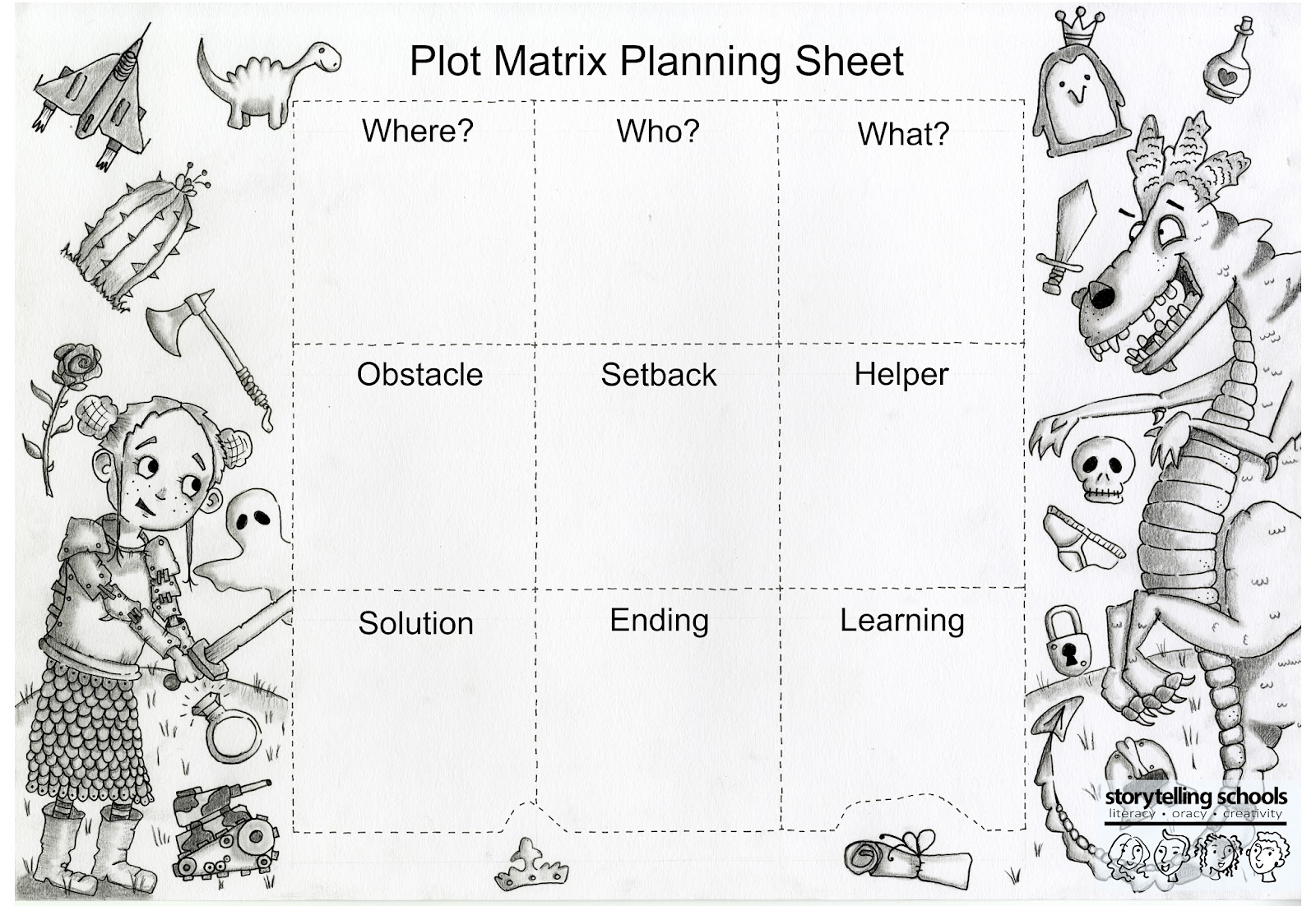
  • Plot Matrix - This should be done as a whole group.
This can be filled out in writing or pictures.


  • Mood map - Could use the Mood map for each matrix. This also should be done as a whole group.


Learning through talk - M.O.E. p.7 2009


Deepening activities
  • Play - Story spoons, puppets, props, costumes, Painted stones, small world play, story suitcase, living exhibition story (items from a story)
  • Character interviews / Hot seaters interview
  • Story map can be put on display after the plot matrix is done.
  • Thought Tunnel - pros and cons


PBL ideas

Story corner with books and props
Story mat


We felt that it would be a great way to improve our children’s listening and oral language skills, not to mention expanding their vocabulary. We both came away excited about getting storytelling started in our school.

Written by  Joanne & Kathleen


Monday, 20 May 2019

Hawker Brownlow Thinking and Learning Conference- Melbourne 2019


Hi all.

Having just returned from Melbourne, I again find myself pretty enthusiastic after a lot of new learning.  The Hawker Brownlow conference ran from Thursday -Sunday and had an amazing range of quality presenters.  What was also impressive was the personal touch, I was able to meet and talk more with presenters, which I did when the opportunity arose. Tables were also set up that allowed conversation rather than the class, long line stadium seating approach.

The conference was set up so that you could either attend full days with presenters for a more in-depth opportunity of learning or you could move around to cover multiple topics but obviously more briefly.

I ended up spending a significant amount of time with Tony Swainston, who spoke about Emotional intelligence for leadership and also professional growth coaching.  I am very excited and inspired by the benefits of coaching and intend to try some of this out and look further into.  Massive companies such as KPMG and Price Waterhouse use a lot of coaching and reap 4:1 Return on their investment due to it, this can't be ignored.  When Tony took us through the process, I could see how empowering it could be for staff if delivered authentically, which is one of its challenges.

http://tonyswainston.com/


4MAT system- When you are learning anything- Bernice McCarthy
People need to understand :
Why
What
How
If- What if…. Creative, New, Unique

EI also develops KASH
K- Knowledge
A- Attitude
S-Skills
H-Habits

Emotional intelligence may be the best predictor of success in life itself, redefining what it means to be smart.

EI supports…
Self-actualisation, getting a buzz from what we are doing, satisfaction
Optimism
Stress tolerance
Happiness
Assertiveness

It is a cultural change

Defensive culture v Constructive culture
Makes an enormous difference, 4 times higher when constructive v defensive.


Defensive culture
Constructive culture
Income
166%
682%
Share price
74%
901%
Profit
1%
756%

EI is about awareness and taking action


Dr Daniel Goleman says that an individuals success depends 20% on IQ and 80% on EQ.
EQ v IQ = 4:1

Schools focus too much on IQ, IQ is your ticket, need it for jobs, Uni etc… Will this change?  Why does society continue to measure this way? I hope this changes over time.

"We often count everything that is easy to count but not everything that can be counted, counts and not everything that counts, can be counted".  Einstein.

Well being rubrix to be assessed against… Set up as part of 2019 strategic plan perhaps! Key competencies, developing EI in students/staff, What does this mean for secondary schools and Higher education institutes?

What are the four biggest actions of great leaders? Admired leaders *Kouzes and Posner*
Honest
Forward-looking
Inspiring
Competent

Tweaks for transformation, not the next big thing!


Ask ourselves, what have I done today that has contributed towards the values of this school/organisation?


Leading a team requires a powerful vision!   We MUST settle on our vision. Why do we have it?  What is our purpose? What will we do with the vision, once it is determined?
Pathway to success
Pathway to greatness
Refresh, learn, grow, along the pathway to success- What does it mean? Unpack Refresh, learn, grow.

What is important is that we are all working towards the vision, we don’t have to do it the same way necessarily...  Ship analogy, can’t travel in a linear line, elements of steps forward then backwards etc…

“The only thing more contagious than enthusiasm is the lack of it” Focus on the positives.

Daniel Pink describes 3 critical conditions for an intrinsic motivational environment
Autonomy, let them decide how to do it, be in control, time used, tasks, techniques
Mastery- opportunity to master their work and make progress through deliberate practice(trying to get better, every time we do something)
Purpose- sense of purpose in their work, understand the why.
Also by being given the big picture

Motivation through coaching can be a great help in motivating colleagues.


The second speaker I listened to was Kathy Perez- Dynamic differentiation: One size does not fit all   St Marys College California.

Classic start, high paced, music playing, great vibes, reminded me of our music in place of the bell.

“If the bum is numb, the brain is the same”

Activity bank
Hi 5, 3-5 people, state how you are feeling from a bank of choice - passionate, awesome, walking dead, glorious etc…
Fair is not always equal
Slow down to go faster
Brain break/state change are essential- Reflect, connect, relax.

Learning menus, everyone does the entree, choice of mains,  side dishes, dessert for early finishes.

Snowball fight with thoughts/ideas was a lot of fun, could see our students enjoying it, would need to be used immediately before a break time!

Martha Kaufeldt- Growing even smarter brains - How everyone can increase their intelligence?

The brain is the most important organ in the body, why don’t we focus more about how it works?
Growth mindset- One’s ability is mallaeble and can be increased with effort and learning
“My ability and confidence grow with my effort”

Fixed mindset- static, Growth- can be developed

Carol Dweck- Research #1 
Students take IQ test ½ got praised for intelligence- you’re really smart

½ praised for efforts, you tried really hard

#2 choice
What do you want to do today? Easy like the first or harder and you’ll learn a lot
Effort students chose the hard one 90%
IQ- 80% chose easier

Growth mindset- “With time and effort I can get better at whatever I put my mind to…”
Fixed mindset- “Even with effort, this isn’t going to change so why try…”
Teach this to students.

Neural plasticity
Born with over 100 billion neurons in your brain
Changing, structure, function and organisation in relation to new experiences.
Multisensory experiences in enriched environments can stimulate brain growth and development, this supports the learnings around PBL, we are already noticing benefits from this.

Our brains change with time and experience

Provide a supportive , take a risk environment with opportunities to “do over” try again, revisit.

We need to go slower to go faster…

Teach about failure!

Zone of proximal development- if you are not struggling you are not learning.

Fuji kindergarten -Ted Talk- Has trees growing through the buildings and deliberate uneven grass and banks all around it so that students learn how to develop certain muscles and muscle groups quickly.

POWER OF YET
I can’t do this….yet
This doesn’t work...yet
I don’t know….yet
I’m not good at this ...yet.

Growth mindset feedback is important- avoid you’re so smart, praise more of what they can do. Persistence, strategies, effort etc...

Carol Dweck -Ted talk

Anthony Muhammad spoke about the transformational skills of leaders.
https://www.hbe.com.au/anthony-muhammad.html


Anthony Muhammad- The four skills of transformational leaders
Transformational leadership is a leadership approach that causes change in individuals. It enhances motivation, morale and performance.

What qualities must a leader posses to transform behaviour and build consensus?
Trustworthy, relationship builder, visionary, active listener, integrity, competent, model

No one person is fully qualified to become a transformational leader

Reliability v Likeability - You can like someone you don’t trust and trust someone you don’t like.

Healthy cultures are two-way streets, support v accountability

The four critical behaviours :
1) Communication- (Why? Cognitive)  If someone doesn’t understand why they are doing something, they are unlikely to buy in.

Communicate what- Purpose for change - facts/data- stimulate a commitment to a cause bigger than self
Identify starting point for improvement
Stimulate ownership and intrinsic commitment
“Change is inconvenient”
Rationale for purpose - Persuasion
Context- How has this idea been helpful to others in our situation?
Expect resistance - What arguments should I anticipate?
Details - How will this idea be practically implemented in our environment?

You need to do your homework and dig deep into what you want others to do.


2) Building trust- (Who? Emotional)
Trump example- Over 65 million people trust him!  That is the concern,  not him, himself!

EI- Is the ability to identify, assess and control the emotions of oneself, of others and groups. It can be divided into ability EI and trait EI.
Openness to experience- Empathy
Conscientiousness
Extraversion- Have an advantage
Agreeableness- pick and choose my battles
Neuroticism- Sweat the details, organisation

Empathy does not mean that I agree with you, it means that I am listening. Virgin Australia example.
Genuine concern
If you don’t give empathy you can’t receive it.
Listening without rebuttal


3) Support/capacity building - (How? Functional)

What type of support will people need to achieve this? Some people will need more help than others.

Don’t move to accountability until all of the first 3 have been given.


4) Accountability- (Do, Return On Investment)
Develop a system to measure the implementation.
"Come to jesus meeting" lol, face to face discussion if not stepping up

You can’t make a withdrawal until you have made an investment.


Tony Swainston - Outstanding coaching in schools 
 ILM is the UK’s largest body for leadership and management.
Tony offers courses to degree and masters level.

What coaching is….and is not.

Coaching and mentoring are different, there are overlaps but also distinct differences.


Coaching
Mentoring
Belief that individuals hold the answers
Support person has expert knowldge
Advice is not given
Deficit model
Solution focused
Can promote dependence upon the support person
Commitment to spceifc actions
Direction given
Non judgemental
Goal set by support person
Generic helping skills
Specific advice given
Strengths focused model
May be solution focused
Non directive model
Mentor may be judgemental
Goal set by coachee
Support person has the “real” answers
Promotes high degress of independence
May/May not result in specific actions
Both use the skills of questioning, clarifying, reflecting, observing and giving feedback


An inexperienced teacher could be a great coach and a 20-year principal could be hopeless.

KPMG get a 4:1 return on investment due to coaching….  One of the top two effective leadership styles but is one of the least used.

If people are told what to do, they will do it the same way as the leader, it puts a ceiling on it, we want growth, individuality.

Four things you are NOT required to do as a coach :
Giving advice
Offering opinions
Giving instructions
Managing
Leading through coaching but not in a certain direction.

Four things you are not required to be as a coach :
Be an expert
Know the right answers
Be in control
Be the one that will fix it


What do you plan to do with the coaching?
Professional discussions?
Share with leadership team originally
Possible training
Research more about the benefits and impact
Offer it to staff?


Chinese character for listening -
I listen with my ears 
I listen with my eyes
I listen with my heart
I listen and with undivided attention

Requirements for coaching to work :

A clear understanding of how benefits will be assessed
A coherent plan of how coaching is going to operate is created
A developmental culture is adopted
Confidentiality maintained
Internal coaches need to be fully trained and/or external coaches carefully chosen
Rooms allocated to coaching sessions - Privacy, avoid interruptions
Senior leaders carrying out coaching and being coached themselves
Senior leaders themselves being trained in coaching
Time allocated for coaching 


Benefits of coaching :

Students :
A good friend
Better at goal setting
A growth mindset
Better decision maker
More motivated
More resilience
Aware of potential
Positive beliefs

Adults from being coached :
Understanding myself better
Improve my job satisfaction
Solution-focused
Understanding colleagues better
Improve as a teacher
Feel happier
More motivated

Adults from being a coach :
Being a better leader
Better at my job
Learning how to communicate better
More satisfaction
Learning how others solve problems
Better Listener.

If you are interested or want to know more about any of the above, feel free to sing out!


Sunday, 12 May 2019

Numicon Workshop

Numicon Workshop 

Making Maths Real

When: 2 May 2019
Where: Hornby Primary School
Presenter: Margi Leech

What is Numicon?
Numicon is a multi-sensory approach to children's mathematical learning that emphasises three key aspects of doing mathematics:
  • communicating mathematically
  • exploring relationships
  • solving problems in everyday life experiences (generalising)


Numicon follows the principles of learning described by Bruner where children learn best with three presentations used together to create meaning and conceptual understanding. 


Children find it hard to conceptualise numbers because numbers don't really exist. However, using shapes help children explore and build their mathematical understanding which takes a multi-sensory approach focusing on aural and mental work.

It also makes numbers real for the children in the sense that they can touch them and see them. It also makes the number relationship real for them because they can see very clearly how each number is one bigger than the previous one by the pattern. The pattern and the relationship between numbers is a really powerful way of getting children to understand about the number. It supports the children with their understanding of place value and also how numbers fit together, then the relationship between numbers on a number line all through the pattern.

Numicon isn't just restricted to young children working with number ideas. There are lots of problem-solving activities.

Learning Maths using the Numicon:
  • Any groups of objects can be arranged into a pattern that can be 'read'
  • A group then does not have to be counted
  • The concept of 'number' or 'how many' is built
  • Ready to explore relationships with groups
  • Mathematical thinking and communication develops
  • Components or units in groups make up the whole
  • The 'whole idea' think is generalising
  • Generalisations about anything!
  • Numeral symbols have meaning - +&-, =, times & division, $ & %
  • A collaborative approach to problem-solving by explaining, justifying, reasoning and learning together. 
Planning and assessment of Numicon are linked to NZ curriculum and also JAM, IKAN and GloSS assessments can be carried out.

Free resources including videos are available from Numicon NZ as well as its Internation websites. Their International website sits under the 'Oxford Owl' which is a subsidiary of Oxford University Press. Please note that you will need to register yourself first(free) to gain access to Numicon International.

Numicon immediately drew my attention as it's visual and kinesthetic, children learn Maths by 'doing', subsequently building a concrete number concept.  I understand the hard part of Maths learning for children is that the concept of number is abstract, but yet we ask children to think and communicate with abstract concepts. By manipulating the shapes, children can access number knowledge, the relationships of number and all strands of maths easily.  I am looking forward to using Numicon to teach Maths to our children.