Gilberthorpe school

Gilberthorpe school

Monday, 29 April 2019

Teaching in the “age of anxiety


Anxiety symptoms in children are not straight forward, this was a key message from Dr. Emma Woodward.  Emma is a Child, Educational and Community and spoke at the Positive Education New Zealand 2019 Conference.


Anxious feelings can include:
          Fear
          Dread
          Apprehension
          Worry
          Nervousness
          Unease
          Tension

What we might see:
          Anger / hostility
          Excessive questioning
          Seeking validation
          Physical symptoms, e.g. stomach ache, headache, restlessness, irritability
          Avoidance
          Difficulty with sleep
          Trouble with focusing, inattention
          Heightened emotions/meltdowns
          Running away / hiding
          Clinginess
          Crying
          Refusing to go to school/emotionally based school avoidance


“Build resilience and develop self-regulation as both intervention and prevention for anxiety”


So what can we do?
• Build resilience
• Teach emotional regulation skills

Resilience: Having the knowledge and courage to deal with adversity

The knowledge builds the courage, that in turn feeds the learning of new knowledge

Understand the concept of co-regulation
Co-regulation is defined as: “warm and responsive interactions that provide the support, coaching and modelling that children need in order to understand, express and modulate their thoughts, feelings and behaviours”.

Remind children of their previous successes. Be the advocate that reminds them that they are capable and why…

Explicitly teach about emotions & emotional regulation skills
1. Talk about emotions, data, tough but transient
2. Talk about the link between our thoughts, emotions and behaviours
3. Name it to tame it
4. Talk about the tough stuff and how it can be overcome
5. Don’t assume that emotional regulation is a set skill – it’s a life long practice


Four ways to help a child to regulate
1. Somatosensory - Grounding
Notice FIVE things you see around you.
Notice FOUR things you can touch around you. 3: Notice THREE things you hear.
Notice TWO things you can smell.
Notice ONE thing you can taste.

2. Reassurance
“This might feel big now but we can face it together”
“I’m here to help”
“I know you can do this as I’ve seen you work things through before”
“You're okay, I’m here with you”
“You're not in trouble”

3. Relational
Try to understand what is going on by....
         Reflective listening
         Clarifying questions
         Showing empathy

4. Disassociation
          Safe Space
          Regular checks
•          Talk later


Saturday, 27 April 2019

10 lessons learned in 10 years of Positive Education

At the Positive Education New Zealand Conference 2019, I listened to the Vice Principal Charlie Scudamoore from Geelong Grammar School in Australia. This is a Primary and Secondary school. He spoke of the ten things he learned in the years of developing their own positive education programme for their school.


#1 Measure carefully, Baseline data is very important to see trends. Ask good questions. find out what the children think.
#2 Do well being WITH students not TO them.
#3 Train your teachers and non-teachers. And sure everybody knows it is about relationship building.
#4 The teachers mess a lot! Get the teachers ready, they need to be able to teach it properly.
#5 Make sure parents are involved and onboard with your program.
#6 The name of positive Education can make it seem fluffy. There are a number of myths and misunderstandings around Positive Education.
So, what’s ‘negative’ education?
It’s about making students happy
It’s only looking ‘on the bright side’
It’s all about having fun!
It’s about giving every kid an ‘A’
It’s about ignoring weaknesses
It’s what non-academic schools do
It’s wellbeing for rich kids
It is important that we are all speaking the same dialogue when addressing these misunderstandings.
#7 Positive in education is part of the curriculum It is taught implicitly as well as integrated into other learning areas.
#8 The school has not come up with an independent curriculum, but more of a roadmap for positive education
#9 Positive Education must be tailored to each school's context.
#10 Model, Make it stick, Make it positive, Sustained Cultural change.

Positive Education is not about being hit people the timeEdit seasonally does not avoid negative emotions.

Learn it, Live it, Teach it, Embed it

It is like slow cooked food - it is not a quick fix, it takes time


Thursday, 25 April 2019

Longworth Education -Play in the Classroom: Effective teaching and Learning in a Play-Based Classroom

The first thing we did upon arriving at the course was to place ourselves on the continuum of teacher practise. We had to just think about this knowing we are all on a journey and this is where we are starting. Afterwards they stressed that although this is a continuum by no means does it mean that we all need to be working towards being at the number 7. This is not the end point for everyone, it is important to look at what will work for you and your students. They find that most people end up finding that 5 or 6 suits them best. I rated myself a 3 and I think personally I am moving towards 4. We have started our play-based journey but it is a journey which will take a long time to understand and utilise new practises.

Next they shared with us a lot of great background information about how good play is for students. Play is important for all areas of learning and it really develops all aspects: physical, sensorimotor, social, emotional and cognitive. It helps children with some of the most important things that we see a lack of in children these days such as resiliency and higher order thinking. Probably they lack these skills because they tell us there is a real lack of play in the lives of children. In a study done between 1981 and 1997 there was already 25% less general ‘playing’ happening in children’s lives and then when this study was repeated in 2003 it went down by another 7%. Another great reason for doing play is that it is positive for mental health also as well as helping students become calmer. But what are we actually talking about? What is play-based learning as opposed to just playing? The below definition was really helpful to me because sometimes it is easy to get carried away with what you want the students to do. Play-based learning is all about the freedom of choice for students. You can plan cool ideas for students to do but ultimately you have to then not be too sad if nobody decides they want to do it, which I can relate to and I’m sure this will happen throughout our journey.

It is also important to note that through play the students have to have the freedom to quit, which in turn builds intrinsic motivation. It is not the end result that matters but how they are playing and what they are doing. If they spend a long time figuring out how to make a musical instrument and they discover the equipment for themselves and decided to put it together etc. but then they completed it and it looked and sounded horrible it doesn’t matter. There were so many skills they learned within the making of that instrument that they can transfer into future activities, if they were doing it with others there were also many social skills they were developing along the way also.


The play also has to be balanced with intentional teaching. This was a part of the course that really challenged me however as they said they do not have set times when they take groups. It kind of happens when it happens and when the students have settled down into the play. I really struggled with this because I have always been told about the importance of students having structure and predictability, I also wondered how they ensured that all students received adequate time. I don’t know if this aspect is something I will come to understand later but at the moment I struggle to balance the need for play and the high learning needs we have in the classroom.
However there were some very interesting things they said about instructional time that made me think about my teaching and what I am doing everyday. They spoke of the importance of Oral language and how we need to lift the talk and limit the teacher talk. The above statistics were very interesting about the amount of teacher talk in the classroom. Play allows for more time for students to be speaking with each other and adults to develop their speaking and vocabulary. This is also important in instructional teaching and it shocked me to hear that during things like reading groups a question is asked by the teacher every 72 seconds on average yet we only wait on average two seconds for an answer. They tell us if we wait only a further two seconds each time we ask a question this can make a measurable difference in the student’s learning. Something I have certainly tried to think about since when I am talking.


We looked a lot in the course about the development of children, which you can easily see in students arriving at school at the age of 5 who aren’t really ready to be sitting down and learning. In the below developmental stages the pre-operational is typically seen in children aged 3-7 whereas the concrete operational is more seen in 7/8-10 years.

They then started to tell us about how to prepare equipment for play. How do you plan for something that students are supposed to be choosing and creating for themselves? We need to look at the urges we see in our students, see the things that interest them and resource them for things we think they may be able to use to fulfil this urge. Urges can be things like gathering, transporting, constructing, deconstructing, jumping, climbing, digging etc. Playing with fire and water is also an urge and they ask how we can manage this. Personally I find water fine but the thought of exploring fire with any of the children in the hub scares me!


The role of the teacher is to resource the students with equipment but also to lift the play by giving extra knowledge or giving them a resource to help further the play for them. Such as giving the students a book on paper planes if that is what they are doing, you’re not directly telling them everything they need to do but instead helping them along. We can plan activities for instance something that goes along with the big book you’re reading or something else you’ve been working on. The big thing here is it has to be an invitation which they can then choose to accept or not. We can also provide provocations to further the play. All the talk of integration really interested me and I thought how much more powerful our classroom programme would be if we linked more of our learning together. For next term we have looked at this and thought about ways we can link things like the letter of the week, writing activities, poetry, our big book with some things during the play. I am excited to get into this and see if it makes a difference for our learners.


We then heard about loose parts and the things that the children do with them. This video below was really helpful to see and think about all the little random things that they can use to play. As well as thinking about possibilities for break times as well. This again made me think about needing to get more things like this for the students to just be able to make up uses for and develop their imaginations.

At the end of the course they spoke about learning stories and taking lots of pictures of the play. This makes the learning visible and allows students and parents to be able to see the process that the students have gone through in their play as it’s the most important part. Again this is something I intend to work on when I am the roving teacher at the beginning of next term. The course was a good starter and background about beginning play-based learning which was really good, it certainly left me with a lot to think about for the future of play-based learning at Gilberthorpe School.

Unfortunately we ended the course in a lockdown with the horrible events of that day so it has taken a bit longer to process everything we learnt about. Everyone handled this well and the course providers were kind enough to also provide extra notes in case we lost ours, which was very kind.

Thursday, 11 April 2019

Penny for Positive Education Conference 2019

Positive Education New Zealand Conference  - Wellbeing

Penny Osborne
April 2019


I have just attended the two day Positive Education conference on Wellbeing. Barista coffee was flowing for the hordes of people that had travelled around the country to be here at

Christ College with us. This was such a humbling sight after the recent events in ChCh.

I found most of this conference was based around how to incorporate wellbeing into your teaching and embedding it into your classroom, as a non teaching support staff member, I tried to take the most out of it I could, overall I enjoyed it and felt I got some goodness out of it.

Positive education in NZ, the welcome was simple - We need to look after our own wellbeing to care for and teach our tamariki and rangatahi.

We started the day with Charlie Scudamore Vice Principal from Geelong Grammar school, a very passionate and educated man. Charlie has been responsible for the development and implementation of Positive Education at Geelong and travels to conferences promoting the Positive Education model. What is Positive Education? Based on science and research blah blah.. Positive Education sounds great and appears to be working, but I wasn’t there to learn about that, I was there for what I thought was understanding wellbeing, for yourself, your colleagues, your students, everyone that comes into or is in engaged in your school. The staff, the students, the whanau, the BoT..

Charlie is a wonderful speaker and would highly recommend if you ever got the chance to listen to him, do it! This is what I took away from his discussion

Instead of looking at what went well, try what went wrong! You might surprise yourself

Learn it, Live it, Teach it, Embed it

Do wellbeing with the students, not to them or for them. Wellbeing is something that needs to be learned, learn to be comfortable and understand your own well being

Staff, train the staff, all staff but don’t over train them, by doing this you are acknowledging every interaction matters and that non teaching staff play a critical role.( I have seen first hand one of our students, not liking being in class, found the caretaker and was engaged in some gardening with him. The caretaker became the teacher, showing him what were weeds and what the different plants were. The student was asking the caretaker questions about gardens and growing plants, this may not be huge, but to that child, that is how he learned for a part of that day.) 


The Six dimensions of Wellbeing


Positive Relationships - Connectedness and strong relationships for wellbeing. Focus on developing social and emotional skills. Strong school community and culture of respect. kindness and forgiveness.

Positive Emotions - Aiming to help students and staff to develop a stronger understanding of their emotions and those of others.

Positive Health - The link between physical and psychological health. Practising mindfulness and resilience techniques will promote greater health outcomes. Learning or knowing healthy behaviours in terms of exercise, nutrition, and sleep.

Positive Engagement - Finding passions and interests to keep you engaged, being present in what is happening around you.

Positive Accomplishment - encouraging both students and staff to aim for goals that are both highly rewarding to them self, aim high, show determination, and be willing to learn and succeed.

Positive Purpose - Explore understanding, believing in yourself, and deliberately engaging.

Age of Anxiety


Anxiety is on the rise and is a big factor in wellbeing, some strategies for helping yourself or others cope with anxiety.


Grounding - an effective rewiring of the brain (countdown)

5. Notice five things you see around you

4. Notice four things you can touch around you

3. Notice three things you can hear

2. Notice two things you can smell

1. Notice one thing you can taste.


Relational

Understanding what is going on by ..

Reflective learning

Clarifying questions

Showing empathy

Disassociation

Safe space

Regular checks

Talk later

What can we do to help eliminate anxiety?

Empathise and be human

Remain curious and open

Build connections

We might not be able to change everything, but we can change how we respond to it.


Trust and believe you can help.

An emotional brain only learns through experience

Mental Health First Aid


Having the strategies to notice when somebody is struggling with wellbeing issues (mental health challenges)

Think about being in an airport where you have excess baggage, but no trolley to use. Your taxi is waiting and you need to get to that meeting..

You pick up the first bag, not to bad, you got this..

Pick up the second bag, that's a bit heavy but you have to get to that taxi

You pick up the 3rd bag, that's too much, you can’t carry on, but you know you have to, you can’t make the taxi driver ate, or let the meeting down..

STOP!! Know when to put a bag down, know when you need to go, actually bugger it I am going to make 2 trips because I am more important than that.

Mental distress is common

Mental distress can feel permanent

Recovery is always possible

Early intervention is key

Self Regulation - Nigel Latta


By far my favourite speaker of the conference and a wonderful way to end day one.

Nothing like keepin it simple to solve life's biggest problems. Although he did open this by showing a picture of him covered in spiders, as most of you know spiders are a genuine fear of mine. Nigel reckons, if you face your fear you will get over it.. I’m not so sure and will leave the finding out to another day.
Know how to: 

Recognise


Rebalance


Rewire


Your brain is a machine, but don’t always believe everything it tells you. Your brain is your biggest critic, the thing that holds you back the most.

When in doubt, chill the …. Out :)

Day two The critical factors in building whole school wellbeingFactors that appreciates and nurture wellbeing

Realising you are out of balance

Open communication

Having a chance to debrief and not let things fester

Knowing how to have a work/ life balance

Factors that challenge my wellbeing

Myself, I am my biggest critic

Lack of self motivation

Life / work / hobbies - the commitments of others around me

Factors I can influence/ change

Work / life balance

My health

The way I communicate with people

Celebrate the little things

School Wellbeing factors

Check in & Connect time

Be aware of colleagues and their needs

Move on from ‘Fitting in’ to “Make room for”

Make the staffroom more inclusive, acknowledge people daily, include people

Start the change now, Be Brave!

Creating a culture of wellbeing
A wellbeing team needs a purpose, a vision, a mission. You need to work together to develop these. Make it clear the wellbeing team cannot fix others wellbeing, they can provide the tools to help

Get the framework up and running before you push the go button.

Take notice of the needs of your environment, see where people are at with their wellbeing

Involve everyone, ask students what does it mean to be a Gilby kid? (BTB - Better than before)

Build staff relationships and get involved in events together

Make time for support staff to be involved in discussions or sometimes decisions.

Engage with the community, learn from them. Let them share their stories, we all have something to learn from others

We are all learners, we are all teachers.

I went to a couple of the open conversations, but was disheartened to learn that one titled - We’re all in this together - sounds good on paper, but in reality, that was not the case. The speaker started of with what she has done to get wellbeing off the ground in her school, sounding awesome and things I could see being discussed or implemented in our school, She then followed on with a sentence that irritated me.. ‘We do not yet have support staff in the wellbeing mix’, so really they weren’t all in this together.

At the end of the day, regardless of the title everyone should be involved and encouraged to learn it and live it. We all matter, we are all there for the same reason, those children that come to us everyday wanting to be nurtured, cared for, educated and to know they belong.

Saturday, 6 April 2019

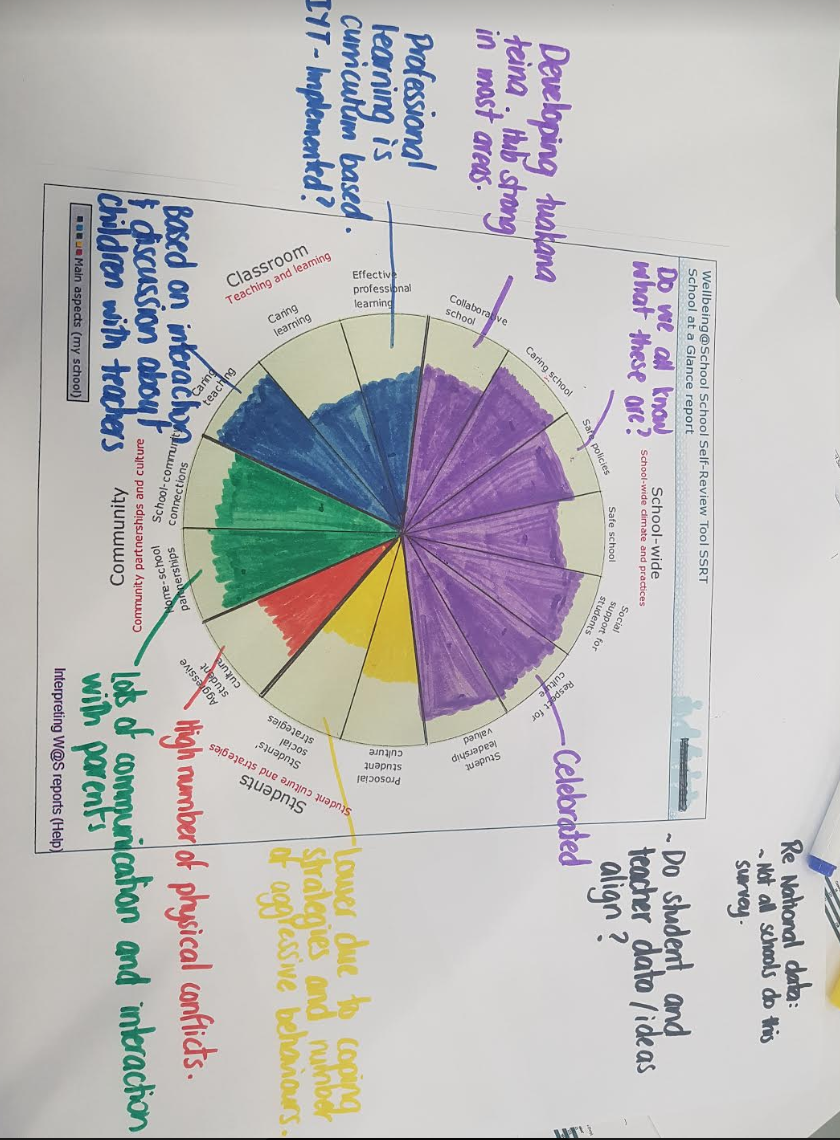
NZCER Wellbeing @ School

Wellbeing at School Survey

Last year I attended a Wellbeing at School workshop through Mana Ake.  It looked at the NZCER Wellbeing @ School Survey.  I have only just found my notes as I tidy up my Google Drive.  We will be doing the survey next term so these seem a little more relevant.
Wellbeing at School
28 August 2018
Somerfield School
Kathy Johnson
Purpose: To determine what the Wellbeing at School tool can offer and to challenge how we use it.
Main Messages:
  • This tool allows you to stop and take a look at what you have done and where you can go.  
  • Is a whole school approach.
  • Focuses on the school climate...the way people feel.  Culture is the way we do things, climate is how we feel.
  • If people feel they belong to a positive school climate, achievement outcomes improve.
  • There are three surveys in this, student, teacher, self review.
  • Looks in to see if what you are doing is working.
  • Lists what a positive school looks like.
  • Key Idea 1: Systems Thinking is increasingly being used as a lens to think about behaviour and schools.  What you might be trying to do, can be undone by somebody within the system.
  • Layers: School wide climate and practices, teaching and learning, community partnerships, pro-social student culture and strategies, aggressive student culture.  
  • Website is set up under these five layers.  Has templates and next step planning within.  Link to Wellbeing at School Website
  • When looking at data, use the scale descriptors alongside.  Descriptors are on the website and are crucial for when looking at data.
  • When you have done the survey, bring a self review team together.  Include the people who will implement policies and procedures. Often, the leadership team data differs from the student perception.  From perception, determines reality. This graph is the first thing you should look at.
  • Administration-student understanding.  Good to have the same person implement the survey, it’s ok to have a discussion around the questions.  Why the dissonance? How well do teachers know the learner? Have guiding focus questions. They should come from any initiatives you have undertaken this year.  Professional development, inquiry, appraisal goals. Use these to refine and drive what you are looking at in the data. Come up with statements that you hope to achieve.  
  • Teacher survey:  Could be done at a staff meeting as shows that it is valued.  Takes about 45 minutes. Raising awareness to why we would want to do this.  
  • The Aspect Report: When looking at graphs, stop and look at these to see if there are any cohorts that stand out.  You are interested in the cohort that stands out. Use the filters to check for trends. Remember we are looking at perceptions.  (Looked at an example where girls thought they were pro social, however, their aggression was high).
  • Two things under your control:  How we teach and how we organise our school.
  • Data is about improvement.  If there is no place to improve, there is no pint gathering data.  An inquiry question comes out of data. Then gather more data.
  • Be deliberate and purposeful in where you are heading?

Thursday, 21 March 2019

Nathan Wallis

21 March
Nathan Wallis
Nathan Wallis

The Human Brain and Responding to Trauma.

Neurosequential Model: 
We have 4 brains and they work bottom to top as they evolve.

Neurosequential Model of the brain

BRAIN 4= top of brain (frontal cortex). Brain 4 does everything we can do that dogs can’t! Think to yourself “can the dog do it?” e.g reading. Quite a high up level of intelligence and our highest form of thinking. Takes a lot to access this brain and we access this at different ages depending on a range of variables. It involves everything at school that involves higher intellect eg. empathy, controls emotions, understands consequences. Stuff that makes us nice people to be around. It’s not just about our genes but 50% relies on nurture too. We learn a lot in the first 1000 days of life that tells us a lot about what we are going to be like. How quickly we mature relies a lot on birth order. Males mature at age 22-32. Females  at age 18-24. If you are the first child born into a family AND the first girl it is likely you will reach adulthood at age 18, later born girls would be age 24. First born boys in a family would reach adulthood age 22, later born age 32. How quickly you reach milestones depends on gender and birth order. Interesting to think about in a school sense. 23 girl might have her shit together as she’s technically been an ‘adult’ for 5 years. Whereas a 23 year old male second born is only halfway through adolescence, not reaching adulthood til 32.... Can’t compare by ages.
BRAIN 3= Emotional brain. Limbic system. We begin accessing this brain between ages 2-8. This is why ECE curriculums are social and emotional.
BRAIN 2= Sports brain (movement brain). Starts around 12 months.
BRAIN 1= Survival brain (brain stem) attachment. We learn this from birth.

If needs haven’t been met in brain 1, 2 and 3 we can’t expect students to do anything to do with brain 4.

We often undervalue brain 3 and focus just on brain 4 in schools. This was due a lot to National Standards and large focus on Numeracy and Literacy. Play based learning!! We need to let kids be kids rather than so much focus on academics. Kids don’t need Literacy and Numeracy to be ready for school. There is no evidence that kids need to know the alphabet etc before they come to school.
If you have two 4 year old children and you give one child two halves of a broken biscuit and the other child a full biscuit, the child with the two broken pieces would lose the plot even though it is technically the same amount of biscuit. They don’t have the logical reasoning and can’t do halves. They are still seeing world in emotional way.

ECE teachers job is to see how a child feels about themselves as a learner. Under age of 8 it’s all about how kids feel. We can’t measure how well they are going to achieve academically as it all plateaus by 8. Studies show that it doesn’t matter!

In our teenage years our brain “shuts for renovations” we start regressing in controlling emotions. We go backwards in brain 4 stuff and begin falling back down into brain 3. Think of a teenage girl not wanting to go to school. She’s size 10 and think she’s fat. Logic goes out window and she begins dealing with her emotional brain. Can’t talk them out of it as they aren’t accessing higher level thinking and functioning that happens in our frontal cortex (brain 4).

In terms of responding to trauma...

Children need to be able to make meaning of trauma.

So how do we meet needs of brain 1,2,3?


Brain 1= DIAD. We can use mindfulness or yoga (able to permanently calm brain stem) but the main way to meet our survival brains needs is through relationships. The relationship with the teacher is crucial. It gives kids a sense of security. Make yourself available to these kids!
Mindfulness calms our amygdala and survival brain. Brings you into the present moment.

MINDFULNESS IDEAS FOR CLASSROOM:
Play classical music when kids come into the classroom. Tuning in helps calm them. Classical music is based on our heartbeat and this is a calming factor for kids.
Box breathing. Inhale for 2, pause for 2, out for 2, pause for 2. Helps calm the brain stem and sets an emotional tone in the classroom.
BRAIN 2= RHYTHMIC PATTERN. It needs to be steady. We need to keep routine and regularity. Doesn’t need to be strict as we must be flexible and respond to our kids needs. We could use singing as way to respond to regulating rhythmic pattern. Start day with waiata? Harvard University carried out a study to show what gives students the most endorphins. After exercise, and laughter it was shown that singing releases a high level of dopamine and serotonin which helps calm our kids. Something to look at in our school...
BRAIN 3= VALIDATE. We need to ensure our students feel safe and secure. Provide movies, games etc when they need it. Make ourselves relatable and ensure other people would have felt those emotions too. Especially in regards to trauma and recent attacks. Children consist of 90% emotion and these emotions need to be validated in ways such as, “Wow, you must of been feeling really angry to do that.” Children come to us when they know their emotions are going to be validated. Think of the one teacher, or friends parent you would go to as a teengager. There was a reason we went to them when we needed to talk. We were being listened to and our thoughts/concerns were understood.
BRAIN 4= COGNITIVE TRAINING. The number one factor in human wellbeing is a coherent life story. We need to get thoughts out of our head. We can do this through talking, writing or playing etc. In terms of talking to kids, we don’t need to talk a lot they just need to get a coherent story about what has happened. Use a strength based statement that models resiliency. “Yes but the police responded really quickly.” Optimism. Acknowledge their pain.

Thinking of behaviour management- if we tell a student “No standing on the chairs” they will then visualise this happening. This happens in our parietal lobe, we can’t tell our brain what not to do. If you say “Don’t picture an elephant” we picture an elephant…. Cognitive training is the most effective way to change behaviour. Tell them what to do rather than what not to do. We need to empower kids with what they should be doing… Teach social skills!

Kids who are the most traumatised are the ones who have nothing said to them. They all know something is going on and if they have no explanation then that’s the worst outcome they could have. We need to say enough that is developmentally appropriate for their level and ‘maturity age’ thinking of what level of the brain they may be in, whether it be brain 1, 2, 3 or 4.

As teachers we must ensure that we are modelling strength and security to our kids. They need to see that it’s okay! We are the ones who need to be a rock for our students.